

Did you know that over 2.6 million pieces of fan art featuring SpongeBob SquarePants are shared online every single year? This beloved cartoon character has captured hearts globally, making him a popular subject for artists.
I will guide you through the complete process of creating your own artwork. My goal is to make this tutorial accessible for creators at any skill level. We will break down the process into simple, manageable steps.
This page offers a professional way to learn draw this iconic sea sponge. You will understand not just the shapes, but also how to capture his unique personality and charm. The techniques used are the same ones professional animators rely on.
By the end, you will have the confidence to create a recognizable and appealing drawing. Let’s begin this creative journey together.
Key Takeaways
- This guide simplifies the process into easy-to-follow steps for all skill levels.
- You will learn professional techniques used by animators.
- The focus is on capturing SpongeBob’s personality, not just copying his shape.
- The tutorial builds from basic sketching to final details.
- You will gain the confidence to draw SpongeBob in his classic pose.
Preparing Your Drawing Tools and Setting Up Your Workspace
The quality of your final artwork begins with thoughtful preparation of your drawing environment and supplies. This tutorial page provides a systematic way to learn draw techniques that professional artists use. Proper setup ensures each step flows smoothly.
Choosing the Right Materials
Selecting appropriate tools makes the learning process more effective. I recommend starting with basic supplies that offer flexibility. Light sketching strokes allow for easy adjustments during the early stages.
Different pencil grades serve specific purposes in the creation process. This table shows the ideal uses for common drawing pencils:
| Pencil Type | Darkness Level | Best For | Eraser Compatibility |
|---|---|---|---|
| HB Pencil | Medium | Initial sketching | Excellent |
| 2B Pencil | Soft/Dark | Final lines | Good |
| 4B Pencil | Very Dark | Shading | Fair |
Setting a Comfortable Drawing Environment
Your workspace significantly impacts your ability to learn draw effectively. Natural lighting or a bright lamp helps you see proportions clearly. A comfortable chair and flat surface provide stability for precise movements.
Having reference materials nearby supports your creative process. This organized approach transforms the way you approach each drawing session.
Understanding SpongeBob’s Unique Features

The true character of SpongeBob SquarePants emerges from his unique design, not a standard cartoon template. His appeal comes from specific shapes and ratios that we will analyze. Mastering these details ensures your final artwork will truly look like the beloved character.
Analyzing the Squiggly Sponge Outline
A perfect square is the wrong starting point. The key is a wavy, irregular outline that mimics a real kitchen sponge. This shape should be slightly narrower at the bottom, forming his iconic silhouette.
The porous texture covering his body is deliberate. I guide you to place ovals of varying sizes strategically. This creates an authentic, spongy appearance across the entire form.
Breaking Down Facial and Body Proportions
His spongebob body follows distinct ratios. The head is roughly 1.5 times taller than it is wide. This creates his signature rectangular shape.
His face features are exaggerated for comedy. Two massive circular eyes dominate the top quarter of his head. They are positioned close together, creating his wide-eyed expression.
A long, curved nose overlaps one eye. Below it, a large, enthusiastic smile stretches across his face. His buck teeth are a signature detail.
| Feature | Proportion Guide | Key Characteristic |
|---|---|---|
| Head Shape | 1.5x taller than wide | Wavy, porous outline |
| Eyes | Fill top quarter of head | Large circles, nearly touching |
| Nose | Long curve, overlaps eye | Prominent and curved |
| Smile | Extends across face width | Wide, with buck teeth |
Understanding these proportions is crucial for consistency. Resources like this detailed guide and this visual tutorial offer excellent reference points. They reinforce the techniques we are covering.
how to draw a spongebob squarepants
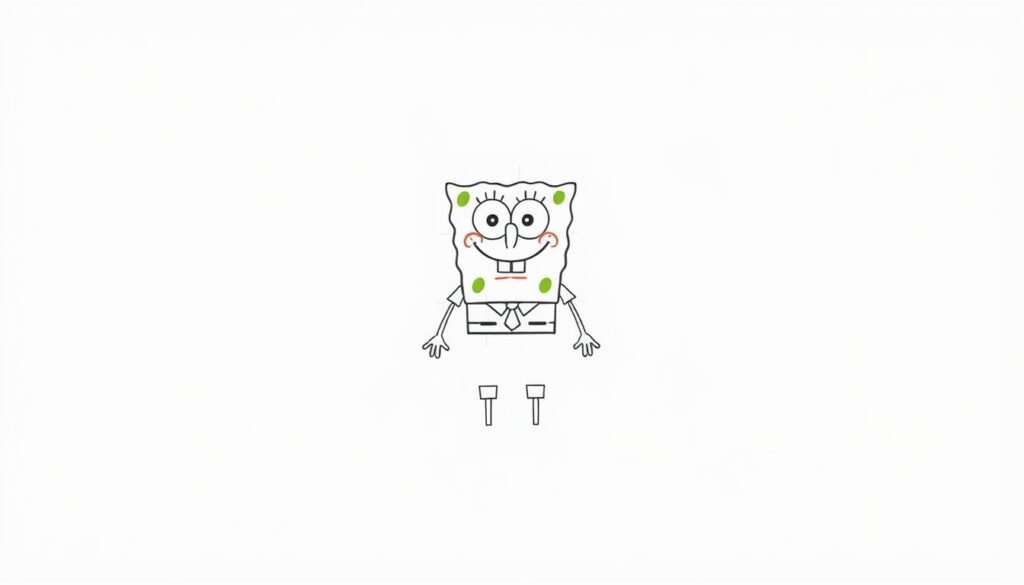
The construction phase brings SpongeBob’s iconic form to life through precise geometric shapes. I guide you through each stage systematically, ensuring every element aligns correctly.
Establishing the Foundation
Begin with a vertical rectangle featuring wavy edges rather than straight lines. Make the bottom slightly narrower than the top for proper proportion.
Add a center vertical line and two horizontal guides. These construction lines help position facial elements accurately.
The torso extends downward as a smaller rectangle. This creates the basic framework for the entire body.
Developing Facial Features
Position two large circles touching at the center on the upper guide line. These form the characteristic eyes that dominate the face.
The nose curves upward from the intersection point, overlapping one eye. Below it, create the wide, enthusiastic smile with distinctive buck teeth.
Add three short lines above each eye for eyelashes. These details enhance the expressive quality.
Completing the Outfit
Sketch the collar using V-shapes at the head’s base. Extend a diamond-shaped tie downward through the torso.
Define the waistline with a straight horizontal mark. Add belt rectangles and pant legs extending downward.
Finish with striped socks and circular shoes. Finally, scatter porous ovals across the surface for authentic texture.
Use light strokes throughout this process. This allows easy adjustment before finalizing your artwork.
Conclusion
With your sketch now complete, the final stage involves bringing your creation to life with color. Apply yellow for the main body, using light brown for the porous texture. Layer these colors carefully for authentic sponge appearance.
This tutorial has guided you through each step of character construction. You’ve mastered the essential techniques professional animators use. Regular practice will strengthen your understanding of proportions and shapes.
Experiment with different expressions to expand your artistic range. The skills you gain from this drawing process apply to other characters too. Your ability to learn draw complex designs will continue growing.
Your finished drawing of SpongeBob SquarePants demonstrates significant artistic progress. Continue applying these construction methods to develop your cartoon artistry further.