

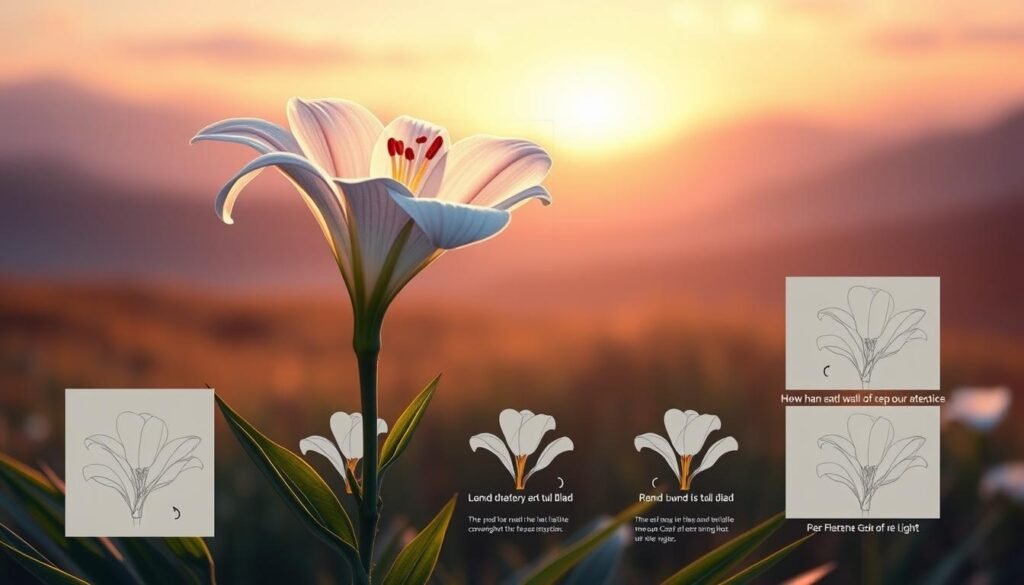
Did you know that artists have been creating lily drawings for nearly 4,000 years? This elegant flower first appeared in symbolic artwork around 1580 B.C. Throughout history, different cultures have used lilies to represent everything from innocence and wealth to sympathy and friendship.
I’ve always been drawn to these magnificent flowers as artistic subjects. Their graceful curves and rich symbolism make them perfect for creative expression. Whether representing a 30th wedding anniversary or simply capturing natural beauty, lilies offer endless inspiration.
This comprehensive guide will walk you through the entire process of creating your own floral masterpiece. We’ll break down the lily’s complex form into simple, manageable stages. Both written instructions and visual references will help you follow along comfortably.
What makes this flower so special is its accessibility. Anyone can learn to create beautiful lily artwork, regardless of current skill level or age. Mistakes are simply part of the journey toward artistic growth.
Once mastered, your lily creations can enhance greeting cards, home decorations, and personal art projects. The versatility of this subject ensures your new skills will serve many creative purposes.
Key Takeaways
- Lilies carry deep symbolic meaning across cultures dating back millennia
- The flower’s elegant form makes it an ideal subject for artistic expression
- This guide uses a step-by-step approach suitable for all skill levels
- Both written and visual learning methods are included for comprehensive instruction
- Mistakes are welcomed as natural parts of the creative learning process
- Mastering lily artwork opens doors to various creative applications
- Floral drawing skills developed here can transfer to other botanical subjects
Introduction to Drawing Lilies
Many find a sense of calm in artistic pursuits, and my personal sanctuary has always been the process of illustrating lilies. There is a meditative quality to observing each delicate curve and translating it onto the page.
Why I Love Drawing Lilies
This particular flower offers a perfect balance. It is complex enough to be engaging yet achievable for artists at various levels. The act of drawing it becomes a form of active mindfulness.
I discovered this passion not in youth, but later. It proves that artistic skill is a learnable craft, not an innate talent. With consistent effort, anyone can master this beautiful subject.
Overview of the Drawing Process
Our approach is methodical and broken into clear stages. We begin with foundational shapes, build up the petals, add intricate details, and finish with shading for depth.
Every artist was first an amateur.
This process is designed to be flexible. You can use any tools you have and work at your own pace. Do not fear mistakes; erasing is a natural part of the creative journey.
For those who prefer visual learning, real-time video tutorials are available. They show the entire creation from start to finish. Set aside some time, be patient with yourself, and enjoy the experience of bringing a lily to life on paper.
Gathering Your Materials and Preparing Your Workspace
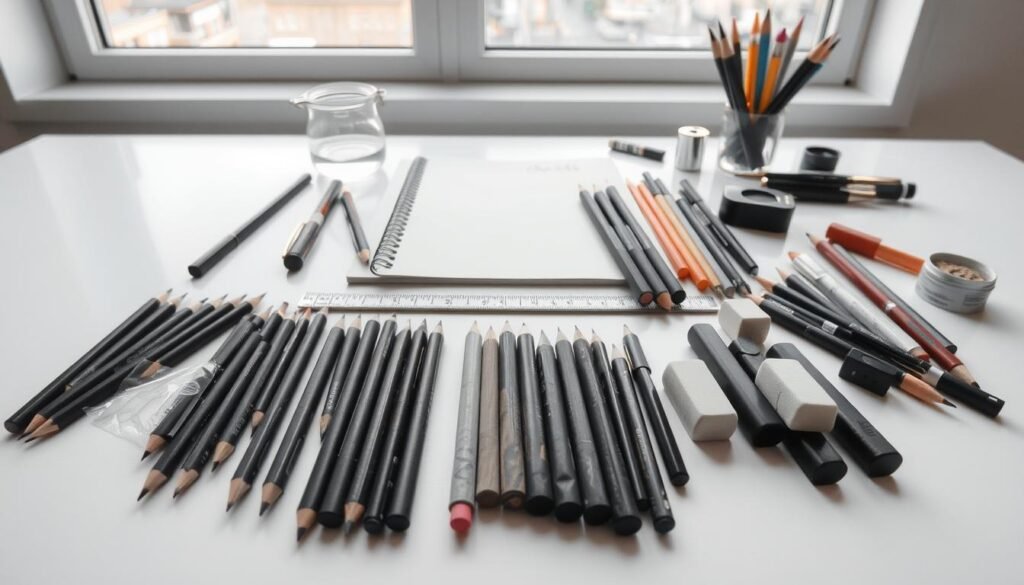
Before putting pencil to paper, thoughtful organization of your workspace can significantly impact your creative flow. A comfortable environment with proper lighting reduces strain and helps you focus on the artistic process.
Essential Supplies and Tools
You don’t need expensive equipment to create beautiful artwork. Basic supplies work perfectly for this project. Any pencil will serve well for initial sketches.
I prefer standard graphite pencils for building the foundation. Any eraser is essential for corrections. Don’t hesitate to erase mistakes—it’s a natural part of the creative journey.
Your choice of paper matters less than your comfort with it. While Rhodia paper offers professional quality, any sketchpad works wonderfully. For inking, Micron pens in sizes 01, 03, and 05 provide excellent results.
A single pen size works perfectly if that’s what you have available. Consider adding color with crayons, colored pencils, or markers if desired. Many artists find helpful resources in comprehensive drawing tutorials that include traceable templates.
These supplemental materials can build confidence before freehand work. Remember that the quality of your tools enhances but doesn’t define your artistic success.
How to Draw a Lily: Step-by-Step Process
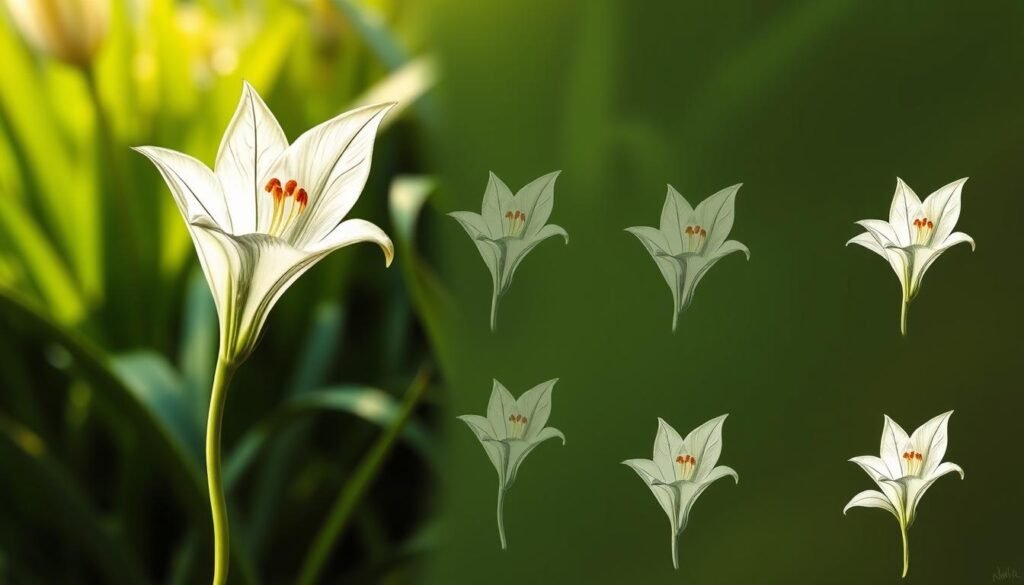
The moment has arrived to translate our understanding of lily anatomy into tangible form on the page. This systematic approach breaks the complex flower into manageable stages.
Sketching the Base Shapes and Structure
Begin with a small, flattened circle as your foundation. Leave ample space above and below this central base.
Position a sphere slightly above your initial shape. Connect these elements with two thin vertical lines forming the stem structure.
Constructing Petals and Nodes
Add small nodes to each side of the stem, placing one slightly higher for natural asymmetry. Draw curved guide lines extending right, left, and forward from the base.
These center lines establish petal placement. Build outward with flowing curves, creating overlap at the base for dimensional depth.
Detailing and Finalizing the Flower’s Form
Complete the six petals with varied shapes and subtle imperfections. Add center lines following each petal’s natural curve.
Include the distinctive stamen with bulbous ends. Finalize the main stem and add leaves with pointed tips for botanical accuracy.
Enhancing Your Lily with Shading and Additional Details

Shading breathes life into your floral creation, turning flat shapes into realistic botanical forms. This stage transforms your initial sketch into a dimensional masterpiece.
Proper shading techniques create the illusion of depth and texture. They make your artwork appear three-dimensional on a two-dimensional surface.
Techniques for Effective Shading
Begin shading by adding lines to the left and right petals near the base. Draw these lines moving outward from the center, following each petal’s natural curve.
Focus on areas where petals overlap, as shadows naturally form there. The stem connection point also requires shading to show it goes underneath the flower.
For comprehensive guidance on advanced shading methods, explore this detailed lily flower drawing tutorial.
Adding Texture and Depth to Petals and Stem
Use fine lines to create delicate texture across each petal surface. Add many short lines toward the center to create darker values and enhance depth perception.
Ink the outer edges with thicker lines, especially where petals overlap. Fill dark spots near the center with solid black for dramatic contrast.
Complete your artwork by adding characteristic speckles using small dots and circles. This final touch gives your lily authentic botanical appearance.
Conclusion
Your finished lily artwork represents more than just lines on paper—it’s proof of your creative potential. I learned this skill later in life, demonstrating that anyone can learn draw with dedication. Celebrate this achievement regardless of your starting point.
Apply your new ability to create personalized cards or decorate personal items. Continue building your floral portfolio with free flower sketching tutorials for sunflowers, roses, and other beautiful flowers. Each new subject strengthens your overall artistic process.
For alternative learning formats, explore our video tutorials showing real-time creation. Downloadable worksheets and printable workbooks accelerate skill development. Share this post with friends to spread artistic inspiration.
Thank you for joining me in this creative journey. Your commitment to practicing different flowers will yield remarkable growth over time. Keep exploring, and remember—every drawing brings you closer to mastering floral artistry.