

I still remember the excitement when I first started drawing. Drawing a cute bunny was something that really caught my eye. With time and effort, I got really good at it.
Drawing is a great hobby that can be very calming. Drawing simple things like bunnies is perfect for beginners. In this article, I’ll share how I learned to draw a bunny in just five easy steps.
By following these steps, you can make your own cute bunny drawings. It’s easy and doesn’t need much stuff, so anyone can do it.
Key Takeaways
- Learn the basic steps to draw a bunny
- Understand the importance of practice in improving drawing skills
- Discover simple techniques to create cute and endearing bunny drawings
- Explore the therapeutic benefits of drawing
- Start your drawing journey with simple subjects
Introduction to Drawing a Bunny
I started drawing a bunny to relax and tap into my creativity. It turned into a new passion. Drawing a bunny was a great way to begin because of its cute features and simple shapes.
Why I Decided to Draw a Bunny
I chose to draw a bunny because of its universal charm. Bunnies are cute and friendly, making them perfect for artists. I wanted to capture that charm on paper.
The Importance of Practice
Practice is key for improving drawing skills. Drawing a bunny helped me get better at capturing its likeness. It also improved my artistic technique.
Regular practice is essential. It helps you understand proportions, shading, and detail. These are important for a convincing drawing.
Drawing as a Relaxing Activity
Drawing a bunny has been therapeutic for me. It helps me unwind and focus on the creative process. Drawing is calming and a great hobby for relaxation.
Step 1: Gather Your Materials
To start drawing a bunny, you need a few basic materials. The right tools can greatly improve your drawing’s quality.
Choosing the Right Pencils
First, pick your drawing pencil. Beginners should use graphite pencils from HB to 6B. HB pencils are good for initial sketches. Softer pencils like 2B, 4B, and 6B are best for shading and adding depth.
Tip: Always start with a sharp pencil for fine lines and details.
Paper Selection for Drawing
The paper’s quality is key. Choose paper that’s smooth but has some texture. This makes your pencils move smoothly. A heavier paper (around 80-100 gsm) is best to avoid buckling or tearing, which is important for shading and color.
Additional Tools for Detail
There are more tools to help you draw better. A good eraser is essential for fixing mistakes and creating highlights. A blending stump or tortillon can smooth out shading, making your bunny look more real. For detailed work, use a fine-tip pen or marker.
“The right tools can elevate your art from simple sketches to detailed masterpieces.”
With these materials, you’re ready to draw your bunny. Remember, the quality of your materials affects your drawing’s quality. So, choose wisely.
Step 2: Basic Shapes as Building Blocks
Basic shapes are the foundation for drawing a bunny. They help simplify the bunny’s complex forms. This makes your drawing balanced and in proportion.
To begin, break the bunny into its main parts: the body, head, and ears. Use simple shapes like circles, ovals, and rectangles. These shapes help you draw these parts accurately.
Outlining the Bunny’s Body
The bunny’s body is a large oval or circle. This shape is the base of your drawing. Start by drawing a smooth oval for the body. It should be big enough for the head and ears.
Creating the Bunny’s Head
The head is a smaller circle or oval attached to the body. Place the head in line with the body, keeping it in proportion. A cute bunny’s head should be quite large compared to its body.
Sketching the Ears
Bunnies have long ears, which are long, thin triangles or ovals. Draw these shapes on top of the head. Make sure they’re symmetrical and the right size for the head. You can refine them later, but basic shapes help with proportions.
For more detailed guidance on drawing a bunny, check out Instructables. They provide step-by-step instructions.
Step 3: Adding Facial Features
Now that my bunny’s basic shapes are done, it’s time to add its facial features. These features are key to making your bunny look cute and unique.
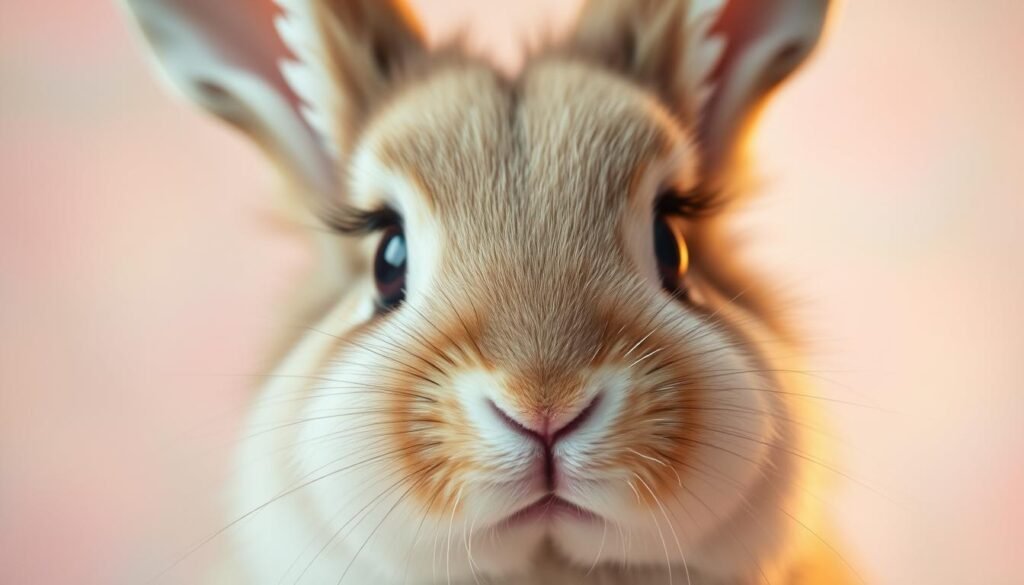
Drawing the Eyes
The eyes are like windows to the soul, making a bunny even more adorable. Start with two oval shapes for the eyes. Make them big and expressive.
Adding a small circle or dot for the iris and a tiny dot for the pupil gives depth. Curves around the eyes suggest eyelids and eyebrows, adding to the bunny’s charm.
Creating the Nose and Mouth
The nose and mouth come next. A bunny’s nose is small and upturned, making it look cute. You can draw it as a triangle or a rounded shape, depending on your style.
The mouth is a simple curved line, showing a smile. You can make it subtle or more pronounced, based on your bunny’s personality. Adding lines around the mouth helps define its face.
Working on the Whiskers
Whiskers are a bunny’s signature feature, adding to their charm. Start by drawing long, thin lines from the nose outwards. These should be soft and curved, like real whiskers.
Vary the whiskers’ length and thickness to match your bunny’s personality. Some bunnies have long, bold whiskers, while others have shorter, more delicate ones. Try different styles to find the perfect fit for your illustration.
Step 4: Refining the Bunny’s Body
The fourth step in drawing a bunny is refining its body. This requires patience and attention to detail. I focus on adding limbs and paws, drawing the tail, and adding fur texture. This makes the drawing more realistic and engaging.
Adding Limbs and Paws
To add limbs and paws, I start by sketching the basic shape of the legs. I consider the bunny’s posture and how it sits or stands. I use gentle, flowing lines to suggest the muscles and contours of the legs.
For the paws, I focus on the arrangement of the toes and the overall shape. I make sure they are in proportion to the rest of the body. Learning to draw rabbits with pen and ink has taught me the importance of delicate lines and shading.
Tail Drawing Techniques
Drawing the tail requires considering its length, fluffiness, and position. I use soft, sweeping strokes to capture the texture and movement of the tail. For a realistic drawing, I ensure the tail is in proportion and blends with the body.
Incorporating Fur Texture
Incorporating fur texture is key for a realistic bunny drawing. I use short, gentle strokes with my pencil, following the fur growth direction. This technique suggests the softness and depth of the fur, adding depth and dimension.
By focusing on texture, I can create a more engaging and lifelike bunny.
Step 5: Adding Color to Your Bunny
The final step in drawing a bunny is adding color. This step needs patience and attention to detail. Color brings your bunny to life, making it look more real and interesting.
Choosing the Right Colors
Picking the right colors for your bunny is key. You can go for classic colors like white, brown, or gray. Or, you can try pastel shades or bright colors. Choose colors that match well and show your bunny’s personality.
Tips for Color Selection:
- Think about where your bunny lives.
- Consider the mood you want to show.
- Look at pictures for ideas.
Techniques for Blending
Blending colors is important for a good bunny drawing. Smooth color changes make your drawing look real and nice. You can blend colors by layering or using wet media like watercolors.
“The art of blending colors is about creating harmony and balance in your artwork.”
Using Shadows and Highlights
Shadows and highlights make your bunny drawing pop. Shadows are darker colors layered on top. Highlights are lighter colors or white. Knowing your light source helps place shadows and highlights right.
As
“Light is the first painter, and its effects can dramatically change the mood of a piece.”
, learning to use shadows and highlights well is key for a great bunny drawing.
By following these steps and practicing, you’ll get better at adding color to your bunny drawing. Your artwork will come alive in a colorful and engaging way.
Common Mistakes When Drawing a Bunny
As I learned to draw bunnies, I found out that avoiding common mistakes was key. Beginners often face similar issues that slow them down.
Overcomplicating the Design
One big mistake is making the design too complicated. It’s easy to get lost in details, but simplicity is what makes a drawing clean and effective. For example, too much detail in the background or on the bunny can take away from the main focus.
Neglecting Proportion
Another mistake is ignoring proportion. Making sure all parts of the bunny are the right size is important. For example, the ears should match the size of the head, and the body should be the right size compared to the limbs.
To get better proportions, try these tips:
- Use reference images to check the size and scale of different parts.
- Sketch lightly at first to make changes before you finalize your drawing.
- Compare your drawing with real-life or photos.
Skipping the Sketching Stage
Another mistake is skipping the sketching stage. This initial sketch is key for getting the basic shapes and proportions right. Rushing through this can lead to a drawing that lacks balance and coherence.
For more detailed guidance on drawing a bunny, check out wikiHow’s tutorial. It offers step-by-step instructions and helpful tips.
By knowing these common mistakes, you can avoid them and get better at drawing. Remember, practice is essential, and learning from mistakes is a big part of the creative journey.
Tips for Improving Your Bunny Drawing Skills
To get better at drawing bunnies, you need to practice, be patient, and follow some tips. It’s important to practice regularly, study real-life bunnies, and connect with other artists.
Continuous Practice and Experimentation
Practicing every day is key to getting better at drawing. Spend time each day drawing bunnies and trying new things. Try drawing in different styles, like realistic or cartoonish, to see what you like best. Start with simple shapes and add details later. Consistency is key to seeing progress.
Studying Real Bunnies and Photos
Looking at real bunnies and their photos can really help your drawing. Notice their ear shape, fur texture, and expressions. Check out this website for tips on drawing bunny faces. Paying attention to these details will make your drawings more realistic and cute.
Joining Drawing Communities
Being part of drawing communities can give you feedback and support. Share your work and learn from others online or in person. This can inspire new ideas and keep you motivated. Some groups even have challenges or workshops to help you improve.
Here are some more tips to improve your bunny drawing skills:
- Try different drawing tools and mediums.
- Look at other artists’ work for inspiration.
- Set goals for your drawing practice.
- Be open to feedback.
By using these tips, you’ll get better at drawing bunnies.
Tools for Digital Bunny Drawing
When I started digital bunny drawing, I found many tools to help. Digital drawing lets artists be more flexible and precise.
Finding the right software is key for top-notch digital art. Recommended software programs can really change your bunny drawing.
Recommended Software Programs
Many software programs are loved by digital artists for their features. Adobe Photoshop and Clip Studio Paint stand out. They have tools for all kinds of art.
- Adobe Photoshop: It’s great for editing and has lots of brushes.
- Clip Studio Paint: It’s easy to use and perfect for comics and manga.
- Krita: It’s free and has lots of brushes and options.
Using a Graphic Tablet
A graphic tablet is key for digital drawing. It lets artists draw on a digital surface. I love using it because it feels natural.
Exploring Online Tutorials
Online tutorials can really help improve your digital bunny drawing. YouTube, Skillshare, and Udemy have lots of tutorials for artists.
“The key to mastering digital drawing lies in consistent practice and a willingness to learn new techniques.” –
With these tools and resources, you can get better at digital bunny drawing. You’ll make art that’s fun and professional.
The Value of Feedback in Drawing
Getting feedback on my bunny drawings changed my art journey. I learned that feedback is key to spotting areas to improve and seeing how far I’ve come.
To really benefit from feedback, it’s important to show your work to others. I started by sharing my drawings with friends. They gave me first thoughts and tips. This boosted my confidence and showed me what was good and what needed work.
Sharing My Work with Friends
Showing my art to friends was my first step in getting feedback. They pointed out things like proportions, colors, and layout. Their comments pushed me to get better and try new things.
Participating in Online Forums
I also joined online forums for drawing and art. These places offered lots of advice and views from artists all over. I picked up new methods, tools, and tips for my bunny drawings.
Constructive Criticism for Growth
The best feedback I got was constructive criticism. It gave me clear, doable advice. This kind of feedback helped me see my errors and fix them, making my drawing much better.
| Feedback Source | Type of Feedback | Impact on Drawing Skills |
|---|---|---|
| Friends | Initial Reactions and Suggestions | Gained Confidence and Insights |
| Online Forums | Diverse Perspectives and Techniques | Learned New Techniques and Best Practices |
| Constructive Criticism | Specific, Actionable Advice | Improved Drawing Skills Significantly |
In conclusion, looking for and using feedback has been key to improving my drawing. I suggest you share your art and talk to others to get better.
Other Cute Animals You Can Draw
Drawing a bunny is just the start. There are many more cute animals to draw. As you get better, you’ll enjoy drawing different adorable creatures.
Drawing a Cat
Cats are loved by many artists. They have elegant poses and faces that show their feelings. Start by drawing the basic shapes like the body, head, and ears.
Make sure the proportions are right. Don’t forget the eyes and whiskers for details.
- Begin with the overall shape and posture.
- Refine the facial features, focusing on the eyes.
- Add texture to the fur for a more realistic look.
Sketching a Puppy
Puppies are very cute with their fun nature and floppy ears. To draw a puppy, focus on its happy face and how it moves.
- Sketch the basic shape, including the head and body.
- Add details such as the eyes, nose, and mouth.
- Emphasize the puppy’s playful features, like its ears and tail.
Creating Adorable Farm Animals
Farm animals, like lambs and piglets, are full of inspiration. They are so innocent and charming.
To draw farm animals, look at their special traits and how they act. Focus on their unique features, like a lamb’s soft wool or a piglet’s playful nature.
- Study the animal’s characteristics.
- Sketch their basic forms and refine the details.
- Capture their expressions and postures.
By trying to draw these cute animals, you’ll get better at drawing. You’ll also find new fun in being creative.
Inspiration from Bunny Artwork
Learning to draw bunnies is more than just mastering techniques. It’s about finding inspiration everywhere. As I explored creating bunny artwork, I found inspiration in many places.
Famous Bunny Illustrators I Admire
My main inspiration comes from famous bunny illustrators. Beatrix Potter, known for Peter Rabbit, has greatly influenced me. Her ability to capture bunnies’ essence inspires me to do the same. You can learn more about Beatrix Potter’s work on Lemon8.
“The secret to creating endearing characters lies in the details and the love you put into your work.”
Finding Inspiration in Nature
Nature is a huge source of inspiration for my bunny drawings. Watching real bunnies and their habitats adds authenticity. Even just visiting parks or watching bunny videos can spark inspiration.
Utilizing Social Media as a Resource
Social media is a treasure trove of inspiration. Following artists and joining communities not only inspires me but also helps me grow. Instagram and Pinterest are full of talented artists who inspire me every day.
| Source of Inspiration | Description | Impact on Artwork |
|---|---|---|
| Famous Illustrators | Studying the work of renowned artists | Improves technique and style |
| Nature | Observing real bunnies and their habitats | Adds authenticity to drawings |
| Social Media | Following artists and joining communities | Provides inspiration and feedback |
By embracing these diverse sources of inspiration, I’ve improved my bunny artwork. And I continue to grow as an artist.
Challenges I Faced While Learning
Learning to draw a bunny was tough. I had to keep going even when it was hard. I faced many obstacles that tested my will to learn.
Overcoming Frustration
Frustration was a big challenge for me. Sometimes, my drawings didn’t look right, and I felt down. To deal with this, I took breaks and focused on the moment while drawing.
This helped me enjoy the process more. It made me less worried about the end result.
Balancing Perfectionism and Progress
Struggling with perfection was another big challenge. As a beginner, I wanted everything to be perfect. But this made it hard to keep moving forward.
I learned that mistakes are part of learning. So, I set achievable goals and celebrated small wins. This helped me find a balance.
Staying Motivated
Keeping motivated was key. I tried new things and mediums to keep things interesting. I also looked at other artists’ work and joined a drawing group.
This kept me excited and gave me new ideas. It helped me grow as an artist.
By facing these challenges head-on, I made good progress in drawing a bunny. I learned a lot about staying strong, being kind to myself, and loving the creative journey.
Tailoring Your Bunny for Different Styles
As I kept drawing bunnies, I found joy in trying new styles. This helped me grow as an artist and explore new ways to be creative.
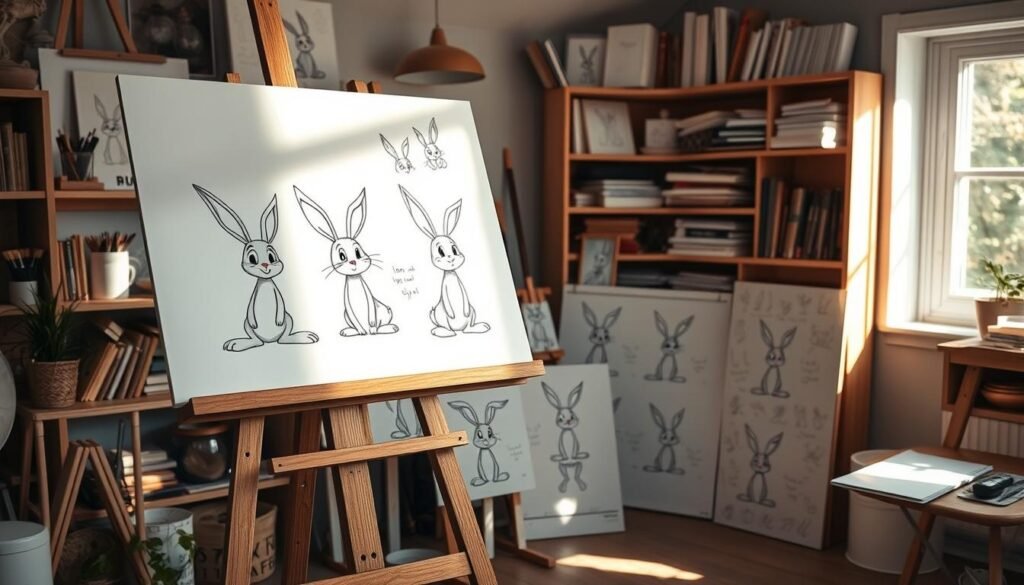
Choosing between cartoonish or realistic bunnies is key. Cartoonish bunnies have big features, bright colors, and a fun vibe. Realistic bunnies need detailed work, correct shapes, and calm colors.
Cartoonish vs. Realistic Approaches
For cartoonish bunnies, I simplify features and highlight their cuteness. I use bold lines, bright colors, and creative anatomy.
Realistic bunnies, on the other hand, need careful detail. This includes fur texture, eye expression, and lighting subtleties.
Exploring Different Art Mediums
The art medium affects a bunny’s style. Watercolors create soft, dreamy looks. Pencils offer detailed, textured art.
| Art Medium | Characteristics | Best For |
|---|---|---|
| Watercolors | Soft, fluid, transparent | Dreamy, ethereal effects |
| Pencils | Detailed, textured, versatile | Realistic, detailed drawings |
| Digital Drawing | Flexible, editable, precise | Cartoonish, graphic designs |
Incorporating Personal Style
Adding personal style to a bunny drawing means using unique touches. This can include special colors, patterns, or techniques.
By trying different styles and techniques, artists can make their bunny drawings stand out.
Final Thoughts on My Bunny Drawing Journey
Looking back, I’m amazed at how far I’ve come. Drawing bunnies has brought me joy and taught me a lot. It’s not just about making art; it’s about the journey, learning, and happiness it brings.
Reflecting on My Progress
I’ve made huge strides since starting. My early drawings were simple and not detailed. But with each try, I grew more confident and skilled.
Consistent practice and a desire to learn were key to my growth. I tried new techniques, materials, and styles. This not only improved my drawing but also deepened my love for art.
Encouraging Others to Start Drawing
If you’re thinking about drawing, go for it. Drawing is a journey, not a destination, and it’s for everyone. You don’t have to be great to enjoy drawing.
Begin with simple exercises, like drawing shapes or a bunny. As you get better, you’ll find your own style and voice.
The Lasting Joy of Art
Art, like drawing, brings lasting joy and fulfillment. It’s a way to express yourself, relax, and create something new. The joy of art is in the journey, not just the end result.
I hope my story encourages you to start your own creative journey. Find joy and satisfaction in the art you make.
In conclusion, my bunny drawing journey has been rewarding. It taught me about art, patience, and self-expression. I hope my story inspires you to start your own creative journey.
Resources for Aspiring Artists
To help aspiring artists like myself, I’ve compiled a list of valuable resources that aided my development.
Looking back, I see how important the right resources were for me. Books and online tutorials were key in my growth as an artist.
Books I Found Helpful
Reading books on drawing and art has been enlightening. Some impactful books I’ve read include:
- The New Drawing on the Right Side of the Brain by Betty Edwards
- Drawing on the Artist Within by Frederick Franck
- The Natural Way to Draw by Kimon Nicolaides
These books gave me valuable insights and techniques to improve my drawing skills.
Online Courses and Workshops
Online courses and workshops have been key in my learning. They offer structured lessons and hands-on experience. Some platforms I recommend include:
- Skillshare
- Udemy
- New Masters Academy
These platforms have courses for all levels, covering various drawing and art topics.
Recommended YouTube Channels for Drawing
YouTube is a treasure trove of drawing tutorials and inspiration. Some of my favorite channels include:
- Proko
- Art Camp
- Sinix Design
These channels share a wealth of information, from basic techniques to advanced topics.
| Resource | Type | Description |
|---|---|---|
| The New Drawing on the Right Side of the Brain | Book | A comprehensive guide to drawing, focusing on perception and technique. |
| Skillshare | Online Course Platform | Offers a variety of courses on drawing and art, suitable for all skill levels. |
| Proko | YouTube Channel | Provides detailed tutorials on figure drawing, anatomy, and more. |
Conclusion: The Joy of Drawing Bunnies
Reflecting on my bunny drawing journey, I feel a deep sense of joy and accomplishment. The 5 easy steps I followed not only taught me a new skill. They also opened a world of creativity for me.
My Artistic Growth
With practice and patience, my artistic skills have grown a lot. Each step, from picking materials to adding colors, boosted my confidence as an artist.
Sharing Your Creations
I encourage you to share your bunny drawings. Whether they’re just starting or have been perfected, they show the joy of drawing. I’m excited to see how you’ve brought this cute subject to life.
Embracing Creativity
Drawing bunnies is more than making art; it’s about having fun and being free. As you keep growing as an artist, remember the joy is in the journey, not just the end.