

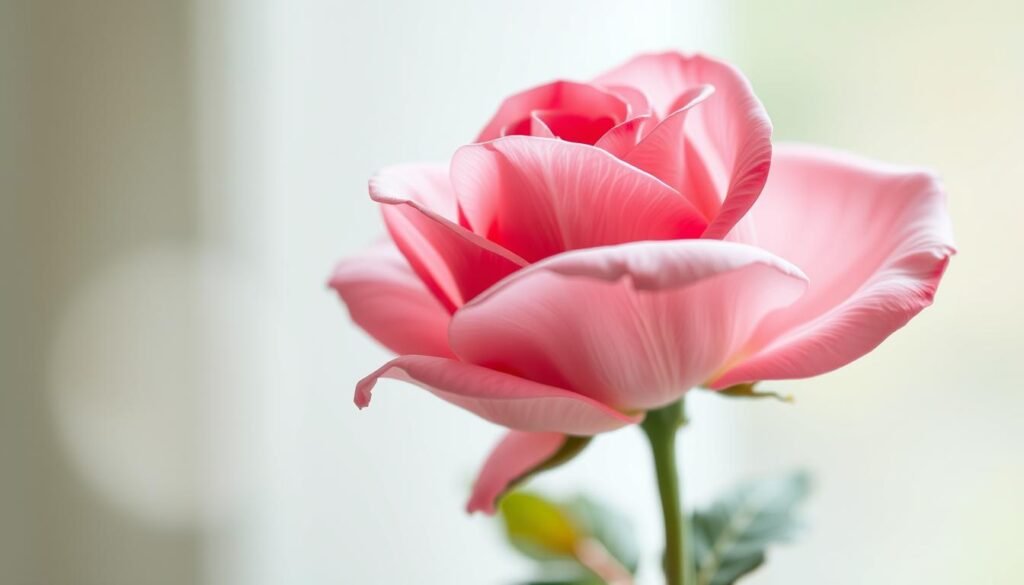
Did you know that the rose is one of the most searched-for flowers to sketch? Its timeless beauty captivates countless aspiring artists every day. Many believe creating a realistic floral illustration requires innate talent, but I am here to show you a different path.
This comprehensive guide is designed for anyone wishing to master this classic subject. I understand that starting a new drawing can feel intimidating. However, with the proper way and a structured approach, stunning results are within your reach.
I have broken the entire process into simple, progressive stages. This method builds confidence by starting with basic shapes. You will gradually add layers of detail, leading to a fully formed and dimensional rose. The techniques shared are used by professionals but presented for clear understanding.
My approach has been refined over time to ensure success for complete beginners. For an even deeper dive, you can explore this detailed guide to draw rose. This tutorial will transform a blank page into a beautiful floral creation.
Key Takeaways
- Drawing a rose is an achievable goal for artists at any skill level.
- A structured, step-by-step method simplifies the entire process.
- Beginning with basic shapes is the foundation for a realistic result.
- Professional techniques are adapted for easy learning and application.
- This guide provides a clear path from a simple sketch to a detailed illustration.
Introduction to Drawing a Rose
My artistic journey began later in life, proving that creativity knows no age limits. Creating botanical illustrations has become my favorite pastime, and I’m genuinely excited to share this creative process with you.
My Drawing Journey and Inspiration
I discovered my passion for floral art as an adult, which demonstrates that artistic skills are learnable abilities. With dedicated practice, anyone can develop the technique needed for beautiful results.
Through extensive experimentation, I developed methods that simplify complex floral structures. This approach makes the process accessible for beginners who might feel overwhelmed. The goal was to create a system that builds confidence through progressive steps.
What You Will Learn in This Guide
This comprehensive tutorial will teach you to construct a rose from basic shapes to finished illustration. You’ll master creating dimensional petals that overlap realistically, bringing your flower to life.how-to-draw-a-tree
We’ll cover everything from initial circular shapes to final shading techniques. You’ll understand how petal placement creates depth in your roses. For additional perspective techniques, explore this detailed guide to floral illustration.
By following this method, you’ll gain confidence to create multiple roses and apply these principles to other flowers. The skills you develop will transform your approach to botanical drawing.
Essential Tools and Materials
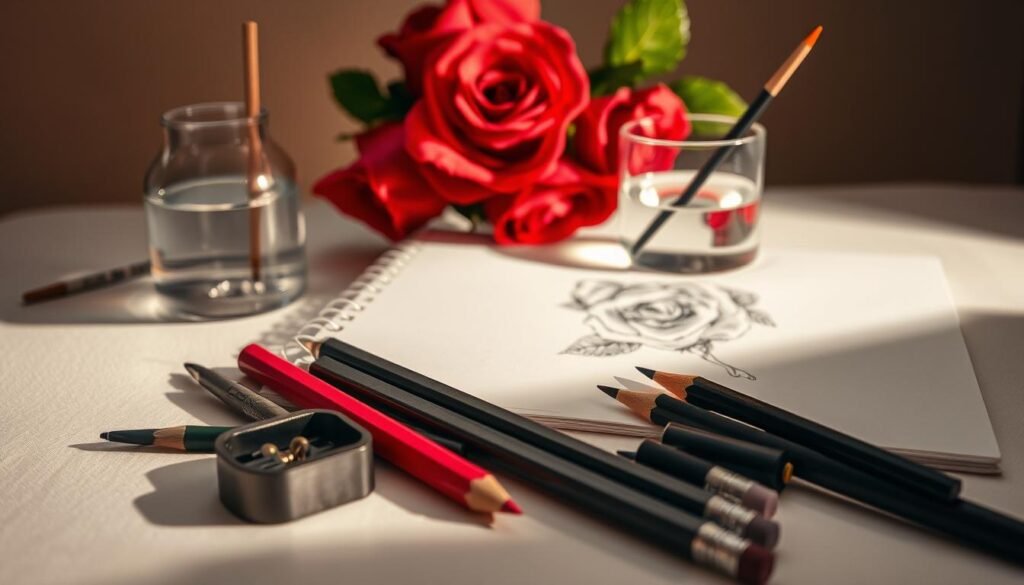
The foundation of any successful artwork begins with selecting quality materials that complement your technique. Having the right supplies makes the creative process smoother and more enjoyable.
I recommend starting with basic but reliable tools. Quality paper and a standard pencil form the core of your artistic toolkit.how-to-draw-a-butterfly
Choosing the Right Paper and Pencils
For my floral illustrations, I prefer Strathmore Bristol paper in 11×14 inch size. This surface handles both sketching and shading beautifully. The texture supports clean lines while allowing for smooth blending.
When selecting pencils, I begin with softer graphite for initial sketches. This approach allows for easy adjustments before committing to final lines. The flexibility of softer pencil marks proves invaluable during the early stages.
Additional Supplies for Shading and Details
Fine-tipped markers add crisp definition to your finished rose illustration. I use them for outlining once the pencil sketch meets my satisfaction.
For coloring, I found Macro Refine Colored pencils to be an affordable alternative to premium brands. They work well for beginners exploring floral drawing. An eraser remains essential for refining your work.
Remember that technique matters more than expensive tools. You can create beautiful results with basic supplies. For more guidance on material selection, visit this comprehensive rose illustration resource.
Preparing Your Sketch: Basic Shapes and Guidelines
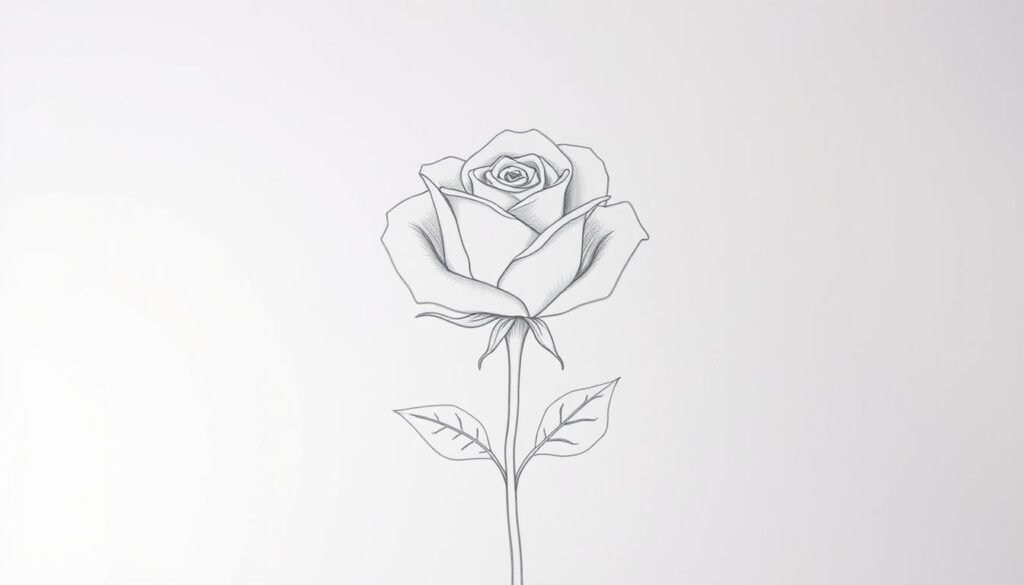
Before adding intricate details, establishing proper proportions through simple shapes is essential. This foundational step creates the underlying structure that supports your entire floral composition.
Establishing the Core Structure of the Rose
Begin with an elongated circle that appears wider than tall. Think of it as a gentle puddle shape rather than a perfect geometric form. This initial circle serves as your primary reference point.
An alternative approach involves creating three nested circles, each slightly larger than the previous. These concentric shapes form the innermost core of your rose bloom. From this central point, all subsequent elements will radiate outward.how-to-draw-sonic
Extend lines downward from the sides of your initial circle. This creates a cylindrical foundation that establishes proper perspective. The goal is capturing general proportions, not achieving perfection.
Setting Up Petal and Stem Guidelines
Proper petal placement begins with strategic guidelines. These reference lines ensure natural overlap and dimensional appearance. Each petal should emerge organically from the central shape.
Create your first visible petal using two curved lines meeting in a V-shape. This pointed form emerges from the flower’s center. For additional guidance on floral structure, explore this comprehensive rose illustration tutorial.
Establish the stem foundation with two parallel lines extending downward. Position them toward the center for realistic connection. These preparatory lines create the framework for your complete botanical drawing.
Step-by-Step Tutorial: how to draw a rose easy step
This stage marks the transition where your sketch evolves from structural guidelines to realistic botanical art. The semicircle becomes your focal point, resembling a sunrise over the horizon within the initial circular boundary.how-to-draw-pokemon
Add a curved line extending past the semicircle’s midpoint. This begins forming the dimensional structure. Each petal should feature two relatively straight sides connected by a curved end.
Building the Flower Core and Overlapping Petals
Create overlapping petals where each new one starts at the previous petal’s line. This layering technique produces the three-dimensional appearance characteristic of roses. Petals should radiate outward from the central area.
Include petals at various angles and depths. Backside petals with less visible surface area indicate positioning further behind the primary blooms. Erase construction lines overlapping front petals for clarity.
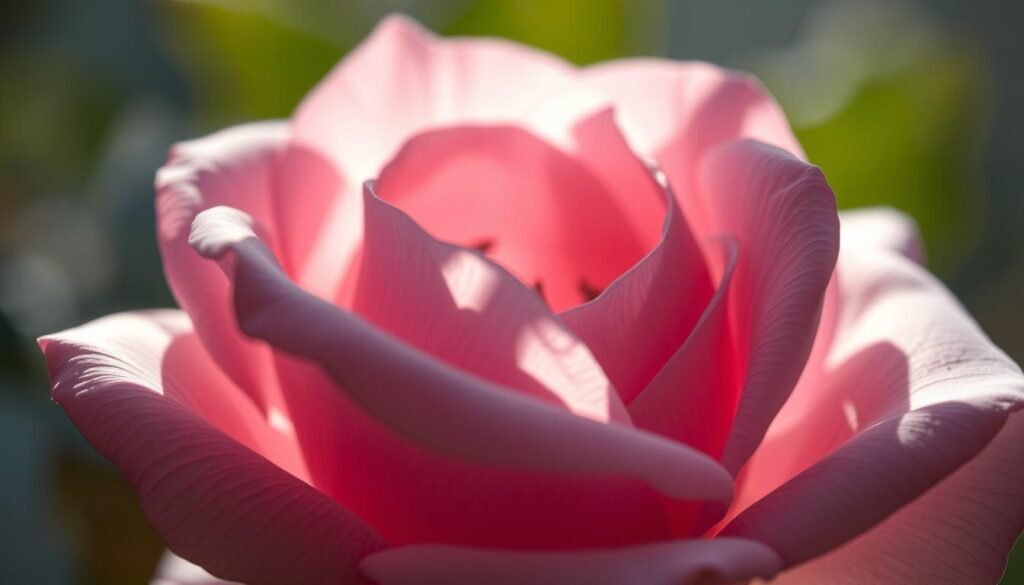
The most convincing floral illustrations emerge when artists understand how light interacts with layered forms.
Applying Shading and Adding Final Details
Apply shading in corners and crevices where light cannot reach. These shadow areas create depth and realism. Follow each petal’s natural contours with your pencil lines.
| Shading Technique | Application Area | Visual Effect |
|---|---|---|
| Directional Lines | Petals radiating from center | Enhanced dimension |
| Gradual Layering | Shadow areas | Natural contrast |
| Selective Darkening | Stem connection point | Structural depth |
Build darker areas gradually through multiple layers. Add shadows where the stem meets the flower base. Final details include small lines on inner cone petals and leaves with center veins.
For additional perspective on completing your artwork, this complete floral illustration tutorial provides comprehensive finishing techniques.
Conclusion
Seeing a beautiful rose emerge from your own pencil is an incredibly rewarding experience. I sincerely thank you for joining me in this creative exploration of flowers. This drawing process proves that artistic skill grows with practice.how-to-draw-the-tiger
Celebrate your completed artwork. Whether from the top or side, constructing petals with overlapping layers is the key to realism. Your creation is perfect for a gift, card, or display.
I invite you to explore other tutorials on the site. Sharing this resource helps spread the joy of art. Mastering shading and light is the final step that brings roses to life with dimension.
With each attempt, your technique will improve. Be proud of the flower on your page—you created it.