


Did you know that drawing animals is one of the most popular creative activities in the United States? Millions of people find joy and relaxation in bringing creatures to life on paper.
I am thrilled to present this comprehensive guide. It is designed to help you create an adorable bunny illustration. Many believe artistic skill is innate, but I am here to show you that anyone can learn.
This tutorial breaks the process into simple, manageable stages. You will start with basic shapes and progress to detailed features. For additional perspectives, you can explore this resource on animal illustration.
My approach focuses on clear instructions. Whether you are a complete novice or looking to refine your technique, this article provides the foundation you need. You will gain the confidence to create beautiful artwork.
Key Takeaways
- This guide simplifies the illustration process into easy-to-follow stages.
- Mastering basic shapes is the foundation for creating realistic animals.
- The techniques shown are accessible for artists of all skill levels.
- You will learn methods for rendering textures like fur effectively.
- Following each step builds confidence and improves your overall artistic ability.
Introduction and Overview
The gentle nature and distinctive features of these creatures create perfect opportunities for artistic exploration. Rabbits possess beautiful characteristics that make them ideal subjects for developing your skills.
Why I Love Drawing Bunnies
I have always been captivated by their endearing features. Those big round eyes, long eyelashes, and incredibly fluffy fur make them irresistible subjects for any artist.
These gentle animals offer the perfect combination of simplicity and challenge. Their aesthetic appeal and gentle charisma translate beautifully onto the page.
What You Will Learn in This Guide
The instructions throughout this page break the process into clear, manageable steps. Many people feel intimidated by animal illustration initially, but the right approach makes it much easier over time.
You will discover fundamental techniques that apply to various artistic endeavors. These skills are valuable for sketching different animals and even people.
Following these steps carefully reveals that creating beautiful artwork is an achievable goal. The process rewards patience and practice with noticeable improvement.
| Fundamental Skill | Artistic Application | Long-term Benefit |
|---|---|---|
| Basic shape construction | Foundation for all animal illustrations | Improved proportion accuracy |
| Texture rendering techniques | Realistic fur and surface details | Enhanced realism in all artwork |
| Light and shadow principles | Creating depth and dimension | Stronger compositional skills |
| Proportional guidelines | Accurate feature placement | Faster sketching ability |
Gathering Tools and Materials

Proper preparation is the first step toward a successful illustration. Having the right materials makes the entire process smoother and more enjoyable.
Quality tools give you greater control and produce superior results. I always gather my supplies before starting any new project.
Essential Pencils and Paper Recommendations
Your choice of pencils is critical. I recommend a set ranging from hard H grades to soft 6B grades. Brands like Koh-I-Noor or Faber-Castell offer excellent quality.
Softer pencils contain more graphite. They create darker marks ideal for shading. This is a key tip for building depth.
For paper, select a sketching sheet with a weight of at least 250 g/m². Heavier paper withstands erasing and layering without tearing. It provides a stable foundation for your work.
Additional Tools: Erasers, Tissues, and Coloring Pencils
An eraser pencil, like the Tombow Mono Zero, is invaluable. It allows for precise corrections, perfect for creating fine details like individual hairs.
Keep tissue or cotton buds nearby for blending graphite smoothly. This technique creates soft transitions in your artwork.
For the darkest areas, use an opaque black coloring pencil. The Faber-Castell Polychromos is my preferred choice. Its matte finish provides a rich, deep black that graphite cannot match.
With these tools, you are fully equipped to follow this detailed tutorial. Every artist can benefit from a well-prepared toolkit.
Basic Sketching Techniques for Bunny
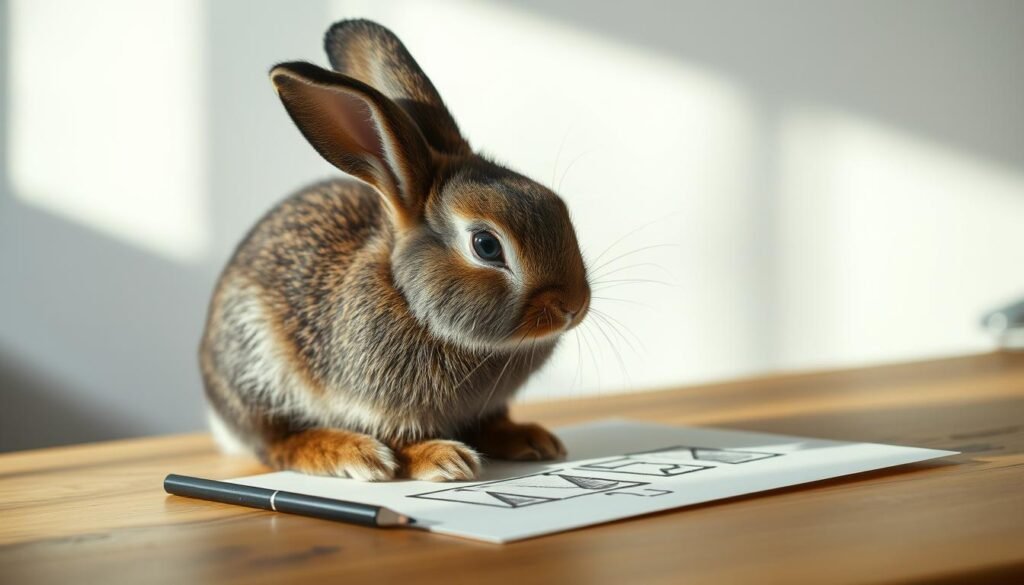
The foundation of any successful animal artwork begins with confident construction lines. I approach each illustration by first establishing the basic framework.
Using an H or HB pencil with light pressure allows for easy adjustments later. This technique prevents permanent marks during the initial stages.
Mapping Out Simple Shapes
Complex forms become manageable when broken into geometric shapes. I start with a long ellipse positioned centrally for the rabbit’s face.
Next, I add two more ellipses for the ears, connecting them to the upper third of the main shape. These circles and ellipses create the basic structure.
Another horizontal ellipse defines the cheek area. For cartoon styles, a bulging square with heart-shaped ears works well. This method ensures proper proportions from the start.
Using Guidelines to Position Facial Features
A central cross through the head provides essential placement guides. The horizontal line indicates eye position.
The vertical line marks the center of the bunny face. These guiding lines help maintain symmetry throughout the process.
Curved lines define the cheek contours, while a small triangle can outline the nose area. Taking time with these foundation shapes makes detailed work much simpler.
Shading and Detailing for a Realistic Look
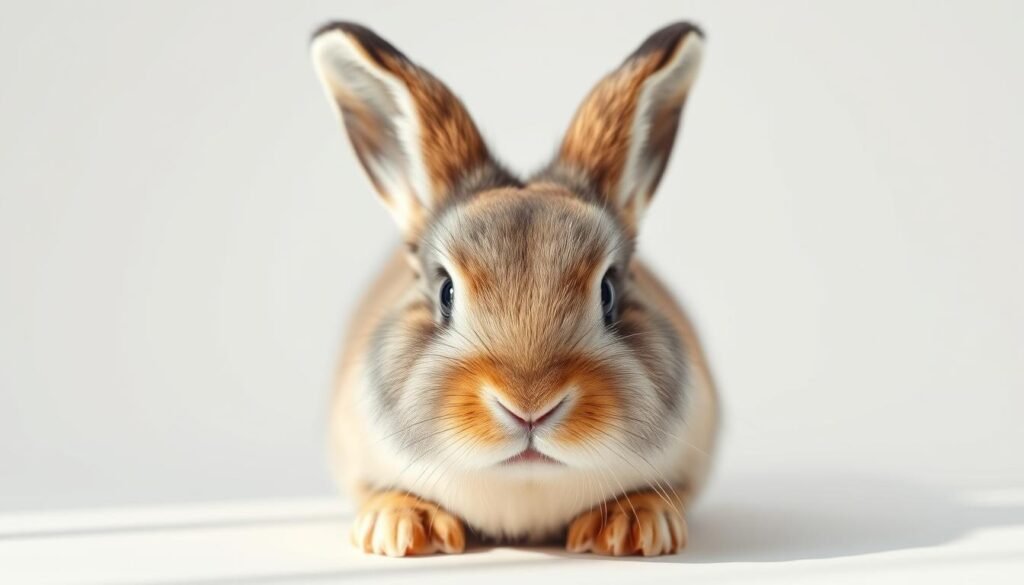
The magic of a flat sketch transforming into a dimensional creature lies in mastering shading and texture. This phase brings your artwork to life.
I build depth gradually, starting with light values. This approach gives you maximum control over the final result.
Light Shading and Gradual Darkening
Identify medium and dark areas on your reference. Fill them lightly with an HB or 2B pencil.
Leave bright spots like around the eyes blank. Next, use a softer 4B pencil for the darkest areas.
Focus on the eyes, nose, and inside ears. This step creates crucial contrast.
Blending, Highlights, and Erasing Tips
Blending is a crucial tip. Use a scrunched tissue to smooth strokes gently.
This creates even transitions. An eraser pencil brings out highlights by removing graphite.
You can even erase individual hairs for added realism. This technique adds sparkle to the eyes.
Drawing Realistic Fur and Textures
Creating convincing fur requires attention to strokes. Use short marks on the head and ears.
On the body, use longer, curved strokes. For the nose, almost draw dots instead of lines.
Pay close attention to natural growth direction. Move your pencil in dynamic, fast motions.
Press firmly at the start and release pressure towards the end. This creates tapered, natural-looking fur.
These methods are shown in my step-by-step instructions. By the end, your sketch will look three-dimensional.
How to Draw Bunny: Step-by-Step Process
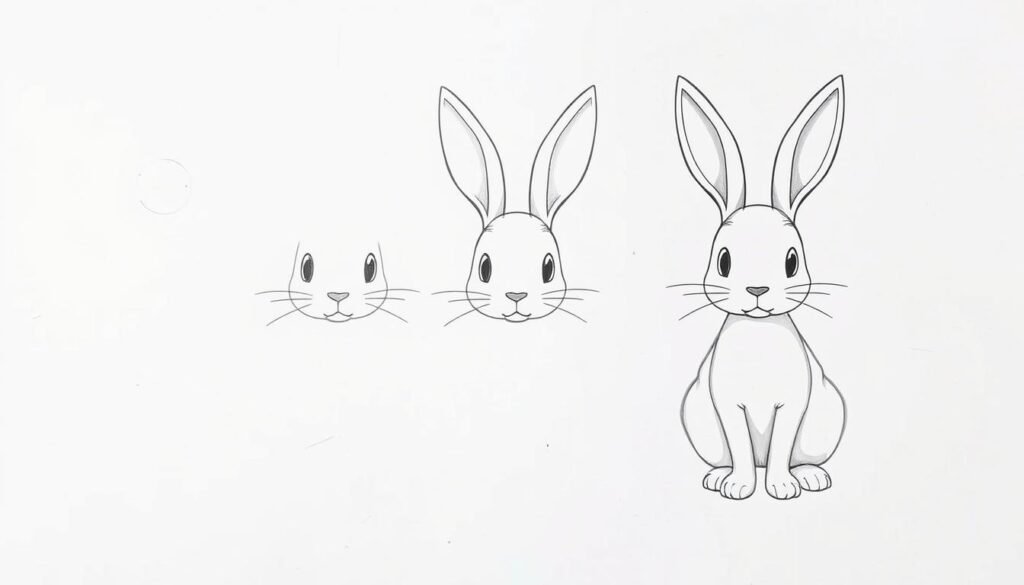
Now we will assemble all the foundational elements into a complete illustration. This process builds upon the basic shape construction and guiding lines we established earlier.
Following these instructions makes the entire project much easier. You will see your bunny come to life on the page.
Sketching the Bunny’s Head, Ears, and Face
Begin with the head. Use a light pencil to map a long ellipse for the face. Add two more ellipses for the ears, connecting them to the top.
Draw a central cross through the head. This guides feature placement. Place the eyes as small circles on the horizontal line.
Sketch an inverted triangle for the nose. The mouth sits just below, completing the nose mouth area. Define the cheeks with soft curved lines.
Constructing the Body with Proportions and Curved Lines
For the bunny body, a large oblong shape works well. Use curved lines for the forelegs. The hind legs can use circles as guides.
Add a small half-circle for the tail. Do not forget the defining whiskers. Use a hard pencil for these fine details.
This method works for various animals. Many people find a video demonstration helpful for seeing the motion.
| Feature | Recommended Shape | Proportion Tip |
|---|---|---|
| Head & Face | Long Ellipse | Use a cross for symmetry |
| Ears | Tapered Ellipses | Attach to upper third of head |
| Body | Large Oblong | Keep it proportional to head size |
| Whiskers | Long, Tapered Lines | Use a hard (H) pencil |
Taking your time with each step is my best tip. For more detailed drawing guidance, explore this resource on rabbit illustration.
Conclusion
You have now reached the final stage of your artistic project. I hope this guide has provided you with the confidence to create beautiful illustrations from start to finish.
The steps and techniques shared on this page are from my own practice. They will help you learn draw skills applicable to many subjects. Remember, artistic ability grows with consistent practice.
Do not be discouraged if early results differ from your vision. This tutorial breaks a complex subject into logical stages. I encourage you to revisit sections to refine your technique.
For another perspective on this process, my detailed tutorial offers further insight. Whether for relaxation or skill development, I wish you great joy in your drawing journey. Thank you for following along.