

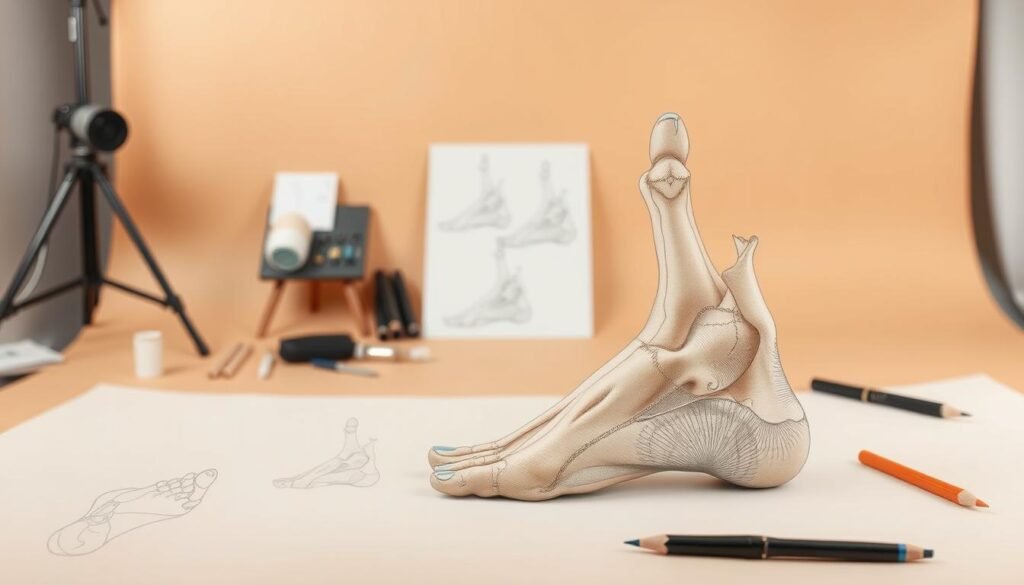
Did you know the human foot contains 26 bones, nearly a quarter of all the bones in your body? This complex structure supports our entire weight and enables movement, making it a fascinating subject for artists.
Many illustrators find rendering feet challenging. Their unique shape and perspective changes can be daunting. I have developed a comprehensive approach to simplify this process.
This guide breaks down the complex anatomy into manageable stages. You will learn a method that combines classical techniques with modern digital art approaches. My goal is to make this skill accessible to artists at any level.
Understanding the structure is crucial for creating believable human figures. Whether you work on portraits or full-body illustrations, accurate feet bring your characters to life. I will cover multiple angles and perspectives for a complete understanding.
By the end, you will possess the confidence to depict a foot accurately in any pose. Let’s begin this journey into artistic anatomy.
Key Takeaways
- Feet have a complex anatomical structure that is essential for realistic figure drawing.
- A step-by-step method makes the process manageable for artists of all skill levels.
- Understanding basic shapes and proportions is the foundation of an accurate depiction.
- Practicing from multiple angles ensures a comprehensive grasp of the subject.
- Avoiding common early mistakes accelerates learning and improves results.
- Combining traditional techniques with modern insights creates a powerful learning approach.
Introduction: My Journey Learning How to Draw a Foot
The complexity of rendering feet accurately initially seemed like an insurmountable obstacle in my artistic development. Their unique anatomical structure presented challenges that differed significantly from other body parts I had mastered.how-to-draw-a-chook
I remember feeling completely overwhelmed when first approaching drawing feet. The arrangement of bones and muscles appeared to defy logical construction. Many art programs overlook this essential subject, focusing instead on more visible features like hands or facial expressions.
Overview of My Artistic Process
Over time, I discovered that feet possess incredible expressive potential. They can convey personality, emotion, and even narrative in character illustrations. This realization transformed my approach in a fundamental way.how-to-draw-a-spider
My methodology evolved through dedicated practice and study of both classical masters and contemporary techniques. I found particular value in resources that address drawing feet alongside hands, as they share similar structural challenges.
The breakthrough came when I learned to deconstruct the foot into basic geometric shapes. This simplification made the process manageable. I spent considerable time observing my own feet and studying photographs from multiple angles.
This personal evolution forms the foundation for the techniques I now teach. Understanding the journey helps contextualize the practical methods that follow.
Materials, Tools, and Preparation for Foot Drawing
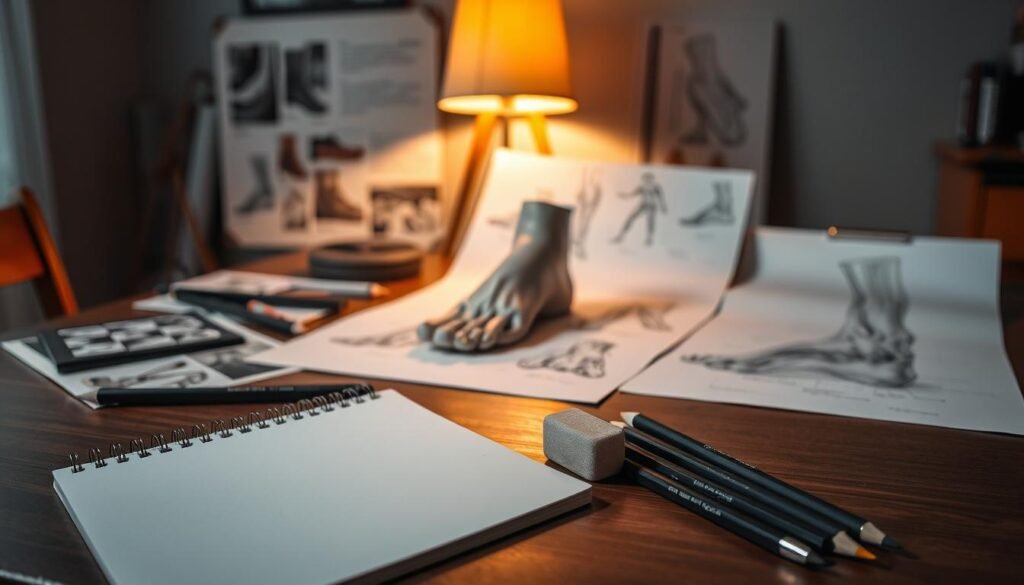
Selecting appropriate drawing supplies creates a foundation for successful anatomical studies. The right equipment streamlines your workflow and enhances learning outcomes significantly.
My own body serves as the most convenient reference model for foot studies. This approach provides endless availability without external dependencies.how-to-how-to-draw-a-unicorn
Choosing the Right Sketchbook and Drawing Media
I prefer B5 and B6 Artist’s Sketchbooks for their flat-laying design and portability. The 120 gsm ivory paper withstands repeated erasures without damage.
Engineered leather covers offer durability while remaining lightweight. This combination supports detailed anatomical work effectively.
Graphite pencils from 2H to 6B create versatile value ranges. Light construction lines evolve into rich shadows with this selection.
Setting Up Your Workspace for Success
Proper lighting reveals form-defining shadows on your reference foot. Position your lamp to emphasize three-dimensional qualities clearly.
A small mirror enables viewing different angles without physical strain. This simple tool expands observational possibilities dramatically.
Keep erasers and blending stumps within easy reach. Organized materials maintain focus throughout your drawing session.how-to-draw-mickey-mouse
Understanding Foot Anatomy and Structure
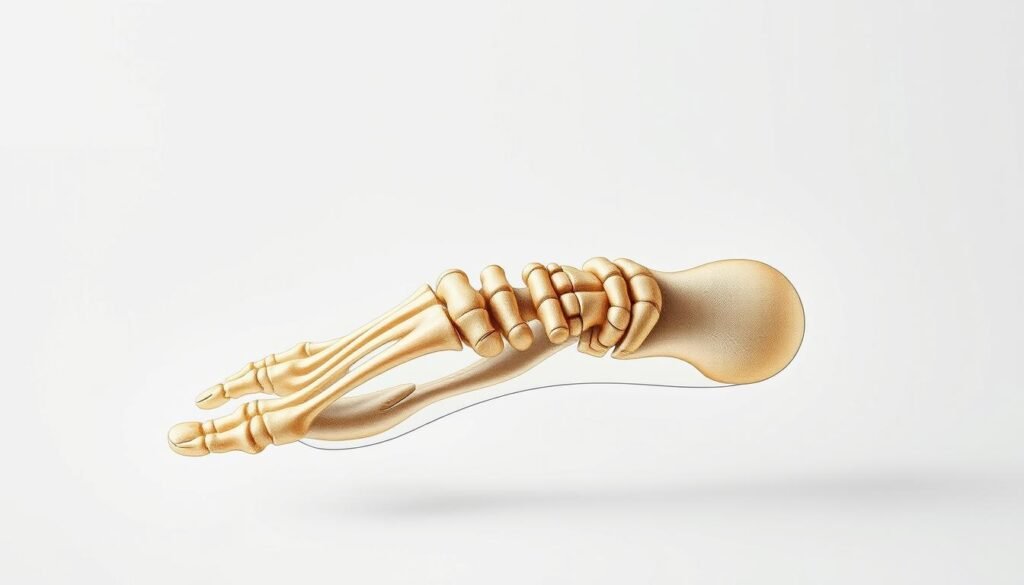
The 26 bones within the foot create a dynamic, shock-absorbing structure that supports the entire body. I find this foundational knowledge crucial for moving beyond simple outlines. It allows me to construct a believable form from the inside out.
Bone Composition and Muscular Details
I always start by visualizing the skeletal framework. The ankle joint is formed by two bones from the leg: the tibia on the inside and the fibula on the outside. They create a wrench-like grip on the main foot bones.how-to-draw-a-gun
This arrangement allows for rotation. The fibula extends lower, creating the visible asymmetry of the inner and outer ankle bones. Understanding these landmarks is essential for accuracy.
The muscles and tendons wrapping this structure give the foot its volume. They connect the foot to the leg, enabling complex movements. I study these muscles to add realistic contour, not just shape.
How the Arch, Heel, and Ankle Interact
The arch is a key engineering feature. It sits directly beneath the ankle, distributing weight efficiently during movement. This alignment is vital for drawing a stable, grounded foot.
The heel bone, or calcaneus, is the largest in the foot. It serves as the anchor for the powerful Achilles tendon. In a profile view, the heel creates the distinctive silhouette I carefully capture.
Artists like Leonardo da Vinci studied this interaction through detailed anatomical drawings. His work underscores the value of knowing what lies beneath the skin for creating realistic art.
Breaking Down Foot Forms into Simple Shapes
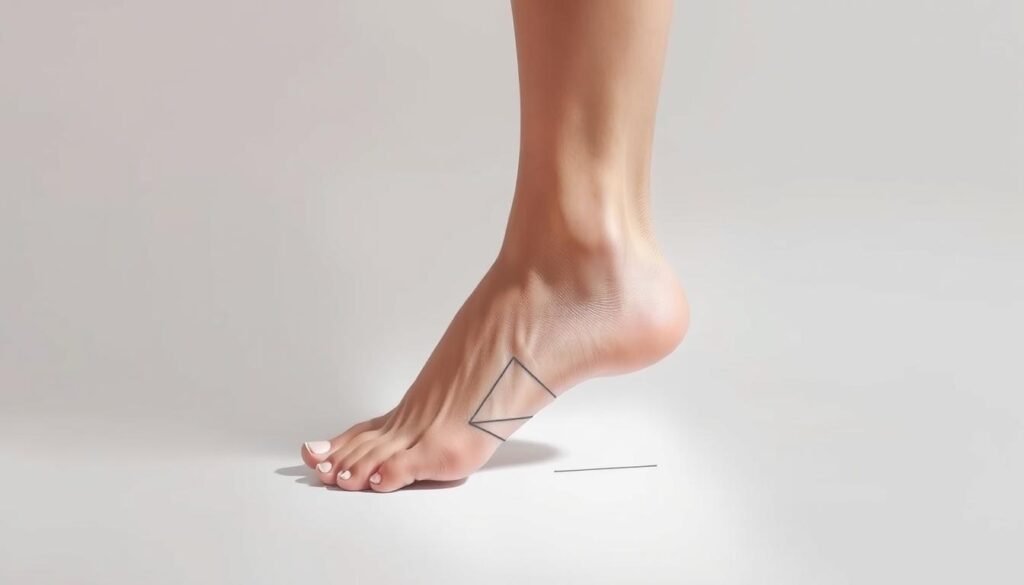
Geometric simplification transforms the challenging subject of feet into an approachable artistic exercise. I find this method particularly effective for beginners who feel overwhelmed by the foot’s intricate appearance.how-to-draw-an-elephant
Simplifying Complex Structures with Basic Shapes
The door wedge serves as my primary reference shape for establishing perspective. This fundamental form immediately grounds the foot to any surface while defining three critical points.
I visualize the ankle as a sphere, the heel as a cube, and the main body as three rectangular forms. This systematic breakdown makes complex anatomy manageable.
“Simple geometric shapes provide the scaffolding for realistic anatomical rendering.”
The table below illustrates my approach to geometric simplification:
| Foot Component | Geometric Shape | Primary Function |
|---|---|---|
| Ankle Area | Sphere | Creates pivot point for movement |
| Heel Structure | Cube | Provides stable foundation |
| Main Foot Body | Three Rectangles | Forms arch and metatarsal framework |
This wedge-based approach works for any viewing angle. Mastering these basics builds confidence before adding anatomical details. The method proves invaluable for creating accurate foot drawings across various perspectives.
Once comfortable with the geometric forms, I gradually introduce organic curves. This transition from simple shapes to realistic contours ensures proper proportion and believability.
How to Draw a Foot: Step-by-Step Process
My systematic approach to constructing a foot starts with three primary shapes that establish the entire framework. This method ensures proper proportions before committing to finer details.
Outlining the Basic Structure
I initiate each study by placing a large circle to represent the ankle joint. This creates the crucial connection point between leg and foot. A smaller circle follows below and slightly outward, marking the heel’s position.how-to-draw-a-cheetah
The third step involves drawing a wedge shape that defines the main body’s height and length. This geometric foundation allows for easy adjustments to the overall form. I sometimes include the toes section at this stage or refine the primary structure first.
Adjusting Proportions and Adding Details
Once satisfied with the basic arrangement, I refine the outline with flowing lines. These curves follow natural anatomical contours, transforming simple shapes into recognizable structure.
The final phase involves adding toes with attention to their tapering sizes and subtle spacing. Each digit integrates naturally with the foot’s architecture. This complete process for drawing feet builds confidence through manageable stages.
Drawing the Foot from the Side View

Working from the side view provides exceptional clarity for understanding the foot’s structural relationships. This perspective reveals the elegant S-curve running from ankle to toes, defining the entire form’s graceful shape.how-to-draw-a-panda
Capturing Inner and Outer Profiles
The inner profile emphasizes the pronounced arch and upward projection of the big toe. This distinctive feature separates it from the other digits immediately.
For the outer side view, more individual toes become visible. I carefully observe how they graduate in size from the largest to the smallest.
When depicting bent toes, I separate the toe wedge from the main foot wedge. Rotating this element maintains proper proportion while capturing natural movement.
Highlighting the Big Toe and Heel Details
The big toe possesses unique anatomical characteristics worth noting. It contains only one joint and angles slightly upward, unlike the other four toes.
Meanwhile, the heel extends backward to create a stable base. This counterbalance supports the forward projection of the toes in the side view.
Mastering this profile helps artists understand how weight distributes across the foot’s entire structure. The lateral perspective remains invaluable for comprehensive anatomical study.
Drawing a Full Front View of the Foot
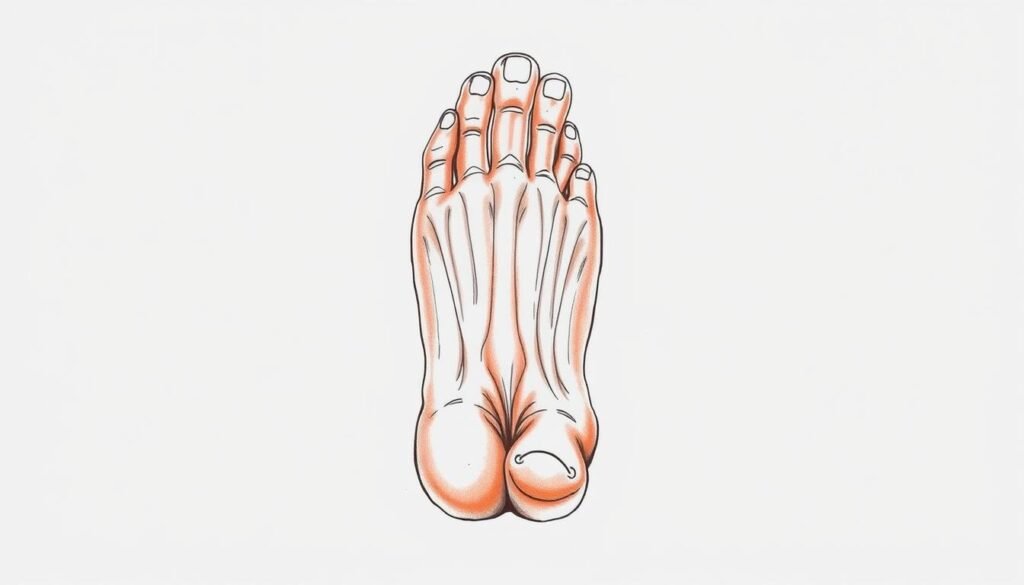
Facing a foot head-on requires careful consideration of compressed proportions and hidden structures. This perspective dramatically shortens the visible length, creating unique artistic challenges.
The initial sketch often appears hoof-like due to extreme foreshortening. I remind myself that shading and detailing will transform this basic shape into a recognizable form.how-to-draw-a-snowman
Overcoming Foreshortening Challenges
My approach begins with a single circle for the ankle joint. The heel remains hidden in this frontal perspective, so I omit its representation entirely.
I construct a tall, narrow wedge rather than the elongated shape used for side views. This foundation captures the compressed nature of the front-facing foot.
A diagonal line across the ankle circle indicates the higher position of the inner ankle bone. This subtle asymmetry adds crucial realism to the drawing.
The toes fan out in a gradual taper from largest to smallest. Proper spacing and relative sizing create natural proportions despite the compressed view.
Foreshortening demands dramatic proportion compression that feels counterintuitive initially. With practice, this technique becomes more intuitive and effective.
Shading plays a vital role in defining three-dimensional volume. Strategic shadows separate the toes and suggest depth in this challenging perspective.
Drawing the Foot from the Back: Flat and Lifted Variations

Viewing the foot from behind reveals anatomical relationships that are hidden in other angles. This perspective showcases the crucial connection between leg and foot through visible structural elements.how-to-draw-a-flower-easy
Depicting the Ankle and Achilles Tendon
For a flat foot position, I begin with the ankle circle and narrow wedge foundation. The Achilles tendon becomes the dominant feature in this view.
This strong vertical line connects the calf muscles to the heel bone. It creates a clear transition into the rounded heel shape that defines the rear profile.
Depending on the specific angle, portions of the big toe and pinky may peek around the sides. These subtle details add realism to the composition.
Understanding Overlapping Shapes and Angles
When the foot lifts from the ground, the heel circle overlaps the ankle circle. The degree of overlap indicates how high the foot is raised.
The bottom surface becomes prominently visible in lifted positions. I emphasize the wedge shape’s flat underside and how light interacts with different planes.
Mastering these overlapping shapes creates convincing depth and three-dimensionality. Each variation presents unique challenges that enhance anatomical understanding.
Drawing the Foot from the Bottom View

Many artists overlook the bottom view, yet it contains essential information about foot function. This perspective reveals weight distribution patterns and structural relationships clearly.
Emphasizing the Sole and Toe Perspectives
I find the sole reveals three distinct zones. The front part near the toes contains two oval-shaped pads. These form the ball of the foot.
The middle zone features the curved arch that bends inward. This creates the characteristic contour. The rear zone shows the rounded heel as a soft spherical hump.
The entire surface possesses pronounced curves rather than flat planes. Understanding these contours is crucial for realistic bottom foot representation.
Natural folds and creases appear across the sole. These lines vary between individuals but follow predictable patterns. They indicate natural flex points during movement.
The big toe contains three fat pads within its wedge shape. This creates subtle volume changes I capture with careful shading. Each toe contributes to the overall form.
Practicing this bottom foot view improves my understanding of mechanics. It informs my drawing feet from all other angles effectively. This perspective builds comprehensive anatomical knowledge.
Incorporating Shading and Detailing for Realism
Shading breathes life into the structural framework of a foot, transforming geometric shapes into a living, weight-bearing form. This process adds the crucial element of mass. My approach treats this stage as the final, defining step for believability.
I always begin by firmly establishing my light source. This decision guides every shadow I place. Building up tones gradually creates a smooth transition from light to dark.
Techniques for Adding Depth and Texture
I use fine hatching lines to indicate the direction of subtle surface planes. These lines are rooted in the underlying anatomy. They appear as half-tones in directly lit scenarios, suggesting form without harsh edges.
Understanding the foot’s fleshy nature is vital. When pressed against a surface, it flattens at contact points. I always look for these areas in photo references to add authenticity.
Using Light and Shadow to Define Form
Key shadow areas include the spaces between toes and under the arch. These details separate elements and create depth. Areas curving away from the light receive the darkest tones.
Finally, I add fine details like skin texture and wrinkles at the joints. Taking time to observe real feet teaches me where these natural elements fall. This careful observation is essential for drawing feet that feel real and grounded.
Practicing Various Foot Shapes and Proportions
Human feet display remarkable diversity in their structural characteristics. I find that recognizing this variation is fundamental for creating believable and unique characters in my artwork. No two foot shapes are identical.
Some individuals possess flat feet where the arch is minimal or absent. This dramatically alters the profile and how the sole contacts the ground. Others have high arches, creating a pronounced curve that affects the entire shape.
Exploring Flat, High-Arched, and Different Toe Lengths
The length of the toes presents another layer of variation. I often observe a big toe that is clearly the longest. Sometimes the second toe matches or even exceeds its length.
When working from life, I carefully measure and compare these proportions. Assuming a standard arrangement leads to generic results. This practice is essential for detailed foot drawing tutorials that capture individuality.
Building a mental library of different foot shapes helps me avoid repetitive designs. This attention to detail makes each character’s feet feel authentic and convincing.
Using References: Leonardo da Vinci and Other Masters
The great Renaissance artists left behind a treasure trove of anatomical studies that continue to inform modern practice. Their detailed observations provide timeless guidance for understanding complex structures.
Learning from Classical Foot Studies
I regularly examine Leonardo da Vinci’s anatomical drawing feet studies. His scientific precision reveals the skeletal and muscular systems with remarkable clarity. These works demonstrate the intersection of art and anatomy.
Masaccio’s “Expulsion of Adam and Eve from Eden” offers another valuable reference. The cropped section showing feet demonstrates emotional expression through anatomical accuracy. Michelangelo’s “Libyan Sibyl” presents dynamic, natural positions that challenge perspective understanding.
Employing Modern Photos and Personal Models
Contemporary photography serves as a practical tool for my work. I photograph other people’s feet in various poses or use my own as convenient models. This approach provides immediate, accessible references.
Drawing from my own body presents unique challenges due to limited flexibility. The awkward angles required to view certain positions test my observational skills. Each part foot study builds my understanding of different perspectives.
I recommend building a comprehensive reference library that combines classical and contemporary sources. This way of working helps me develop nuanced understanding without reinventing solutions. Analyzing masterworks informs my approach to creating believable feet in any context, much like the techniques shared in this informative art resource.
Troubleshooting Common Foot Drawing Issues
Even experienced artists sometimes create unstable-looking feet due to a few persistent anatomical misunderstandings. Correcting these fundamental errors dramatically improves the stability and realism of your figures.
I frequently observe students developing habits that lead to recurring problems. Addressing these issues early builds a stronger foundation for drawing feet accurately.
Correcting Missing Heels and Distorted Toes
A widespread issue involves minimizing the heel, resulting in a “Weeble Wobble” foot that lacks a solid base. The heel must provide a stable platform for the entire structure.
Another common mistake is the placement of the leg and ankle. They should sit directly over the arch, not behind it. This alignment is crucial for supporting body weight.
Many artists also misplace the ankle bones. The inner tibia sits higher than the outer bone, side-by-side, not front-to-back. Understanding this corrects the shape of the foot at the ankle.
When adding toes, remember the big toe has one joint while others have two. This anatomical fact prevents distortion and ensures natural spacing and overlap.
Refining Perspective and Overlays
Shin bones are predominantly straight, not curved. Drawing them with exaggerated curves creates a bow-legged appearance. Subtle accents are all that’s needed.
When I spot these errors in my work, I immediately return to basic shapes. I verify each component’s correct place before proceeding with details.
Comparing your work against anatomical references is the fastest way to identify deviations. Practice those specific problem areas for rapid improvement.
| Common Issue | Anatomical Reality | Quick Correction |
|---|---|---|
| Unstable “Weeble” Heel | Heel is a substantial, weight-bearing part | Emphasize the heel’s volume and flat contact point |
| Misaligned Leg | Leg centers over the foot’s arch | Check the vertical alignment from knee to arch |
| Distorted Toe Joints | Big toe has one joint; others have two | Study reference photos focusing on joint lines |
| Curved Shin Bones | Shin bones are essentially straight | Use light, straight guide lines for the shin |
Conclusion
As we conclude this exploration of foot drawing techniques, the interconnected nature of anatomical knowledge becomes increasingly apparent. This comprehensive post has systematically addressed the challenges artists face when rendering believable feet in various perspectives.
I’ve shared my approach to breaking down complex structure into manageable shapes. Understanding the underlying bones and muscles provides a solid foundation. Each part of the foot contributes to the whole body‘s stability and movement.
Remember that developing this skill requires dedicated time and consistent practice. The tips provided will help you avoid common pitfalls. With regular foot drawing sessions, you’ll develop intuitive understanding.
Mastering this essential part foot representation enhances your overall anatomical comprehension. It allows you to add toes and other details with confidence in any place within your compositions.