

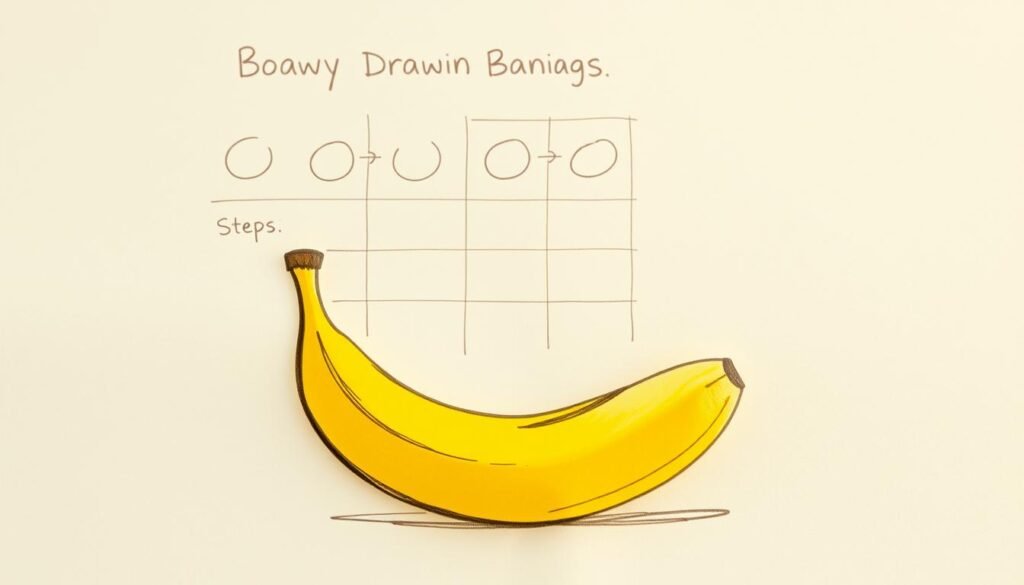
Did you know a raw banana is 75% water? This simple fact reveals the deceptively complex nature of this popular fruit. Its familiar shape hides a wonderful challenge for any artist.
I am thrilled to present this comprehensive tutorial. It is designed for creators at every stage. You will learn to capture the banana‘s elegant curves and subtle textures.
This guide explores multiple artistic approaches. We will cover single fruits, entire bunches, and even peeled variations. The goal is to build your confidence and skill.
You will master techniques for creating realistic dimension and shading. This process, as detailed in my complete guide to fruit illustration, is both fun and rewarding. Let’s begin your artistic journey.
Key Takeaways
- Bananas are an excellent subject for practicing curves, shading, and texture.
- This guide is suitable for artists of all skill levels, from beginner to advanced.
- Learn multiple approaches, including drawing single bananas and bunches.
- Techniques covered range from cartoon styles to photorealistic rendering.
- Develop the ability to illustrate bananas from imagination without references.
- Gain insights into proper proportion and adding realistic details.
Introduction to Drawing Bananas
Botanically classified as berries, bananas offer unexpected complexity for artistic exploration. Their cultivation spans 135 countries, highlighting their universal visual appeal. This widespread familiarity makes them excellent subjects for artistic practice.how-to-draw-a-goat
My Inspiration and First Impressions
I discovered the artistic potential of bananas while studying fundamental principles. Their deceptively simple form teaches volumes about curves, volume, and texture. The organic shapes allow for creative freedom without mathematical precision.
This forgiving nature makes them ideal for artists at any level. Beginners appreciate the approachable silhouette, while advanced creators can explore intricate lighting effects. The journey from basic outline to detailed rendering proves consistently rewarding.
Why Bananas Make Great Art Subjects
Bananas provide multiple learning opportunities within a single subject. Their elongated curves help practice smooth, flowing lines that convey three-dimensional form. The peel demonstrates overlapping planes and texture variation.
Color transitions from green to yellow to brown offer excellent practice for color theory. Whether sketching a single piece or an entire bunch, artists explore composition and spatial relationships. This comprehensive banana drawing guide demonstrates these artistic advantages beautifully.
The distinctive silhouette, composed mostly of water, creates an elegant challenge. It balances simplicity with enough complexity to maintain engagement throughout the creative process.
Tools, Materials, and Setup
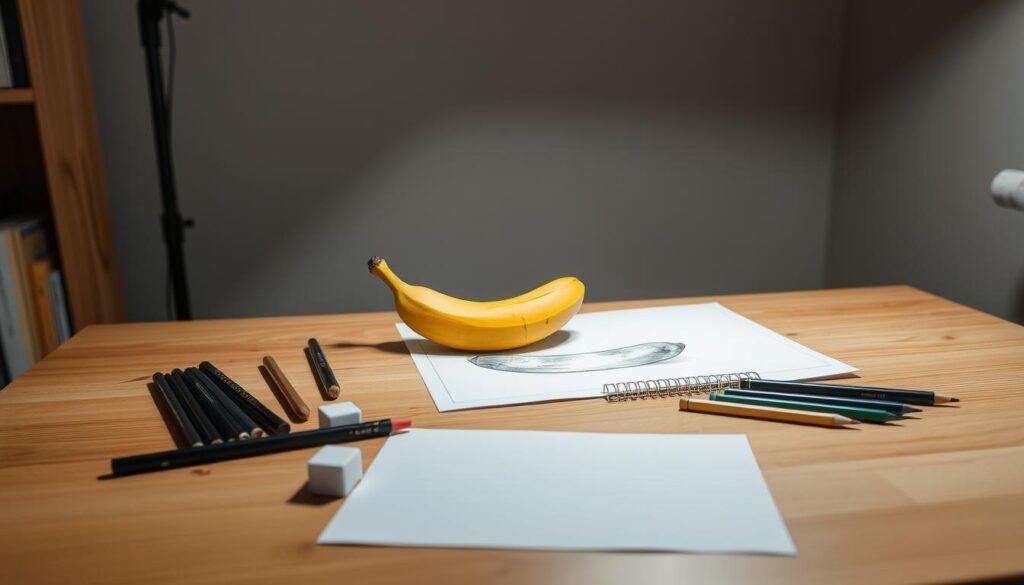
The foundation of any successful artwork begins with thoughtful selection of supplies and workspace arrangement. Proper preparation ensures a smooth creative process from start to finish.
I recommend starting with basic, quality materials that won’t overwhelm beginners. This approach builds confidence while allowing for artistic growth.how-to-draw-a-dinosaur-easy
Essential Drawing Supplies
For physical media, a range of pencils from hard (2H) to soft (6B) provides versatility. Use lighter H-grade pencils for initial construction lines. These create barely visible guidelines that erase easily.
A good eraser and smooth paper complete the basic toolkit. Optional colored pencils or paints add finishing touches. Digital artists should utilize separate layers for construction sketches and final work.
| Pencil Grade | Hardness Level | Best Use | Line Visibility |
|---|---|---|---|
| 2H-H | Hard | Construction lines | Light, erasable |
| HB | Medium | General sketching | Moderate |
| 2B-6B | Soft | Shading & details | Dark, permanent |
Setting Up Your Workspace
Proper lighting makes a significant difference in your drawing experience. Natural light from a window or adjustable desk lamp works best. Avoid harsh shadows on your paper.
Keep a reference fruit nearby to study subtle color variations and light interaction. Organize pencils by hardness and keep erasers within easy reach. A tilted drawing board reduces hand fatigue.
Digital artists should strategically layer their work. Maintain separate layers for rough sketches, clean lines, and color applications. This banana drawing tutorial demonstrates effective layer management.
Regardless of medium, ensure comfortable seating for extended sessions. Keep scrap paper nearby for testing techniques before final application.how-do-i-draw-a-giraffe
Mastering the Fundamentals: How to Draw a Banana
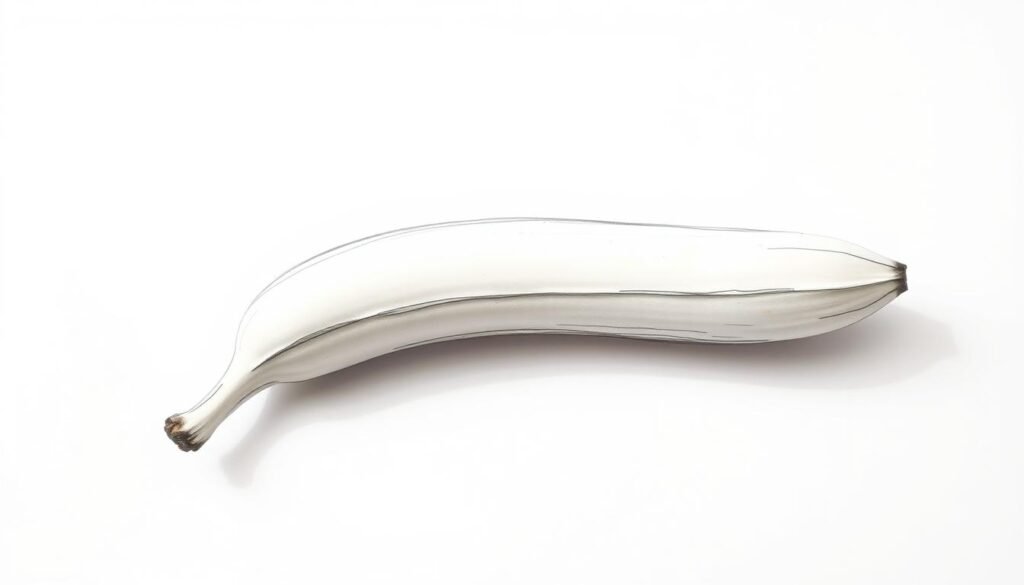
Before adding intricate details, every successful banana representation relies on proper understanding of core shapes. I emphasize that complex forms break down into simple geometric components.
Understanding Shapes and Proportions
The banana is essentially an elongated, curved cylindrical form. It tapers slightly at both ends, creating its distinctive silhouette.
Natural proportions are crucial for realistic artwork. Most fruits measure 7-9 inches in length with a gentle arc. The width typically reaches 1-1.5 inches at the thickest point.
| Aspect | Measurement | Ratio | Characteristic |
|---|---|---|---|
| Length | 7-9 inches | 6:1 to 7:1 | Gentle arc |
| Width | 1-1.5 inches | Width to length | Tapered ends |
| Curve Type | C-shape | Arc consistency | Upward sweep |
Learning to Capture the Banana’s Natural Curve
The defining characteristic is the curved line or “line of action.” This gesture forms the backbone of your banana sketch.
I teach students to observe subtle variations in the form. Bananas aren’t perfectly cylindrical. They feature flattened areas and distinct ridges.
When establishing the basic outline banana shape, start with a single curved line representing the spine. Build parallel curves around this foundation.
The natural curve typically resembles a gentle “C” shape. The stem end usually positions higher than the bottom tip. This creates the characteristic upward sweep.how-to-draw-a-butt
Step-by-Step Banana Construction
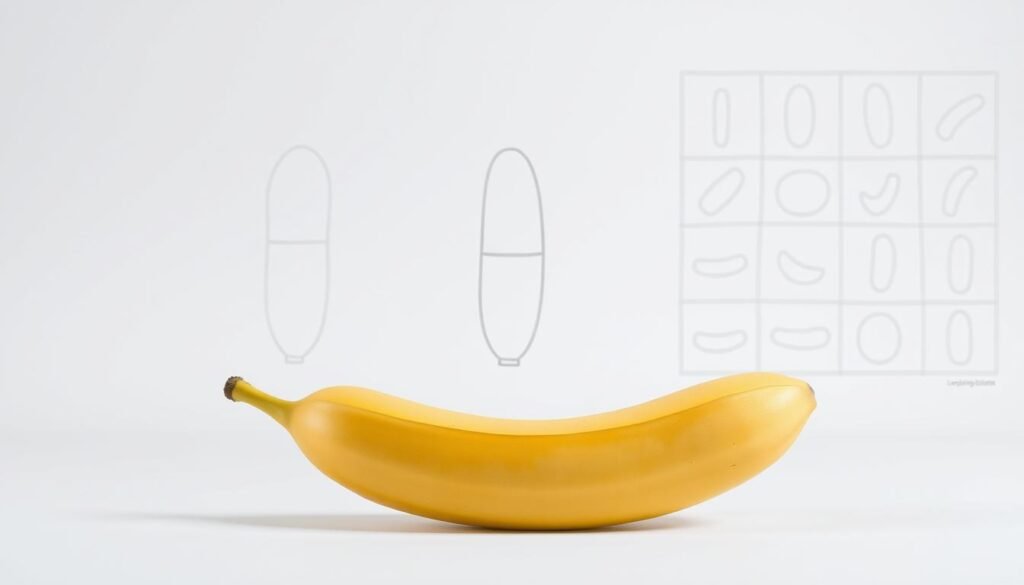
Building an accurate fruit form requires systematic progression from simple to complex elements. I approach this process with careful attention to each construction phase.
Establishing the Gesture Line and Basic Outlines
The first step involves creating a horizontal curved line that sweeps upward. This gesture line determines the overall length and shape of your subject.
Next, position a small circle over the center of this curve. This circle establishes the width at the thickest point. Then draw parallel curves above and below your initial line.
These three curves form the basic cylindrical volume. They create the foundation for the organic form.
Building the Peels and Adding Key Details
Additional curved lines between the main three add realistic dimension. These represent the subtle ridges of the peel surface.
At one end, sketch a thin rectangle for the stem connection. Make it slightly narrower where it meets the fruit body. Add a three-dimensional point with a flat edge.
The opposite end requires an oval shape for the characteristic rounded tip. This completes the basic construction.how-to-draw-a-airplane
Adjusting Lines for a Realistic Look
Carefully erase your guide circle and any overlapping construction lines. This cleanup reveals the clean outline of your subject.
For a convincing organic appearance, slightly curve the ends where lines meet. Avoid sharp, pointy corners that appear artificial.
Each step in this construction process builds upon the previous one. The systematic approach ensures proper proportions and natural curves.
Adding Depth with Light, Shadow, and Color
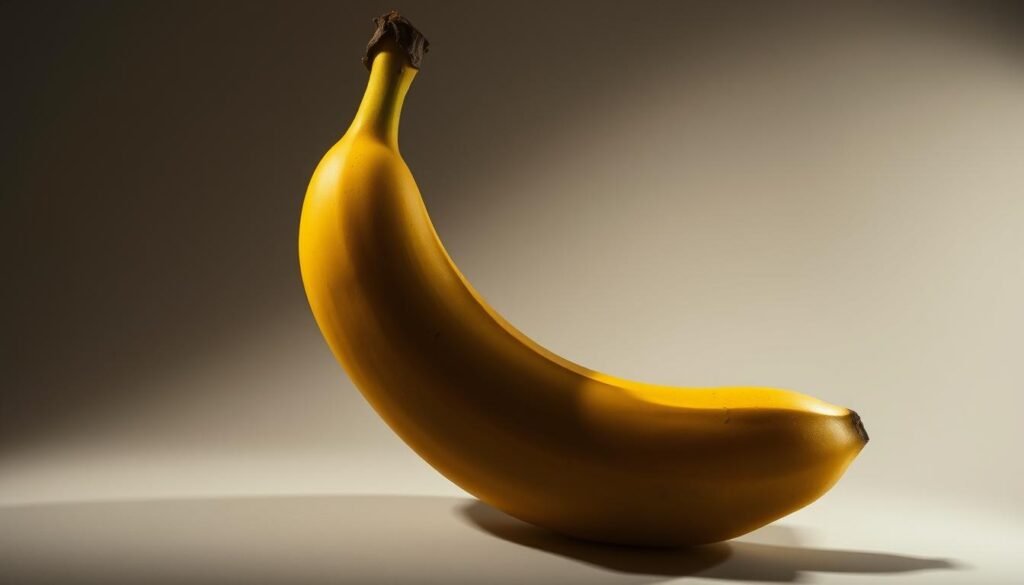
Color and lighting techniques separate basic sketches from compelling, lifelike fruit illustrations. This stage transforms flat outlines into dimensional forms that appear to exist in real space.
Techniques for Shading and Highlighting
I begin by establishing a consistent light source, typically positioning it at the upper right. This creates natural illumination where top surfaces catch light while the bottom curve falls into shadow.
For effective shading, I apply darker tones along the bottom of the fruit where it curves away from the light. Gradual blending creates smooth transitions rather than harsh lines. The core shadow along the bottom remains soft and gradual.how-draw-a-deer
Highlights appear on areas most exposed to light. I use lighter yellow or white on top surfaces to simulate the fruit’s waxy peel. This creates the characteristic glossy appearance.
Selecting the Right Color Palette
The foundation starts with a bright banana yellow base coat applied evenly across the entire form. Realistic coloring extends beyond simple yellow to include subtle variations.
I incorporate light green tones at both ends, especially near the stem and tip. Light brown adds age spots and natural blemishes. Darker brown or black defines the stem attachment point.
Observing real fruit at different ripeness stages informs color selection. Unripe specimens show more green, while overripe ones incorporate browns and blacks in their spotted appearance.
Creative Variations in Banana Drawing
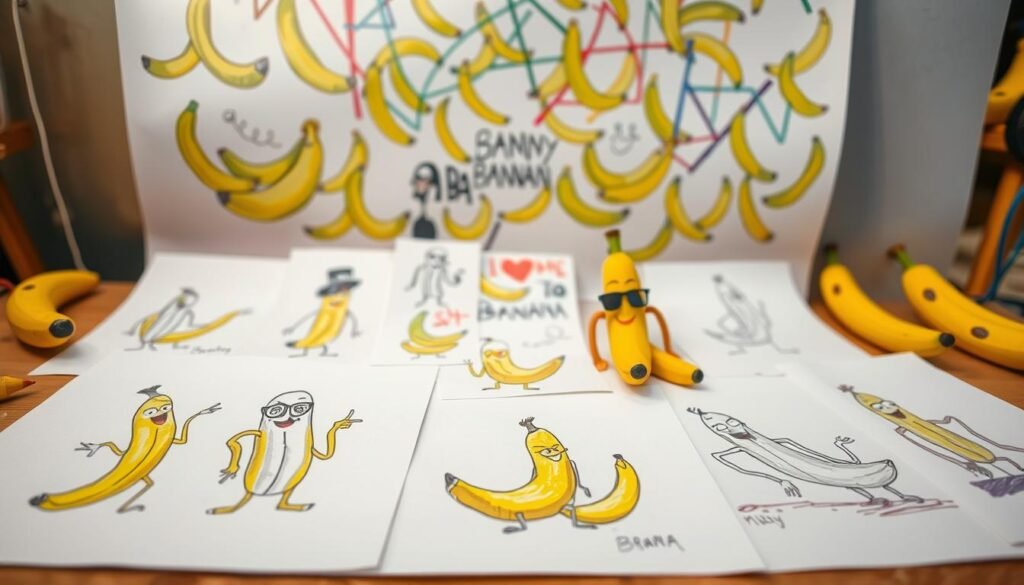
Moving beyond basic representation allows artists to develop unique stylistic approaches. I find this exploration particularly rewarding when working with familiar subjects like this curved fruit.
Cartoon interpretations offer wonderful creative freedom. I simplify the form to its essential curved shape, eliminating subtle ridge lines. Adding playful character elements like expressive eyes creates engaging personalities.how-to-draw-a-bald-eagle
Cartoon Versus Realistic Interpretations
Realistic renderings focus on capturing subtle texture variations. The slightly waxy surface shows occasional brown spots and fine hairline textures. This attention to detail brings authenticity to your artwork.
Creating a bunch presents excellent spatial relationship practice. I start with a small rectangular stem where individual fruits connect. Positioning each piece at different angles creates natural clustering.
Exploring Different Banana Peel Textures
Texture exploration varies with ripeness stages. Green specimens have smoother, firmer-looking surfaces requiring minimal marks. Yellow ones show moderate texture with occasional spots.
Brown overripe fruits display heavy spotting and surface irregularities. This banana drawing guide demonstrates effective texture techniques beautifully.
Alternating between styles develops artistic versatility. Cartoon work teaches simplified form, while realistic sketches enhance observation skills.
Advanced Tips and Troubleshooting
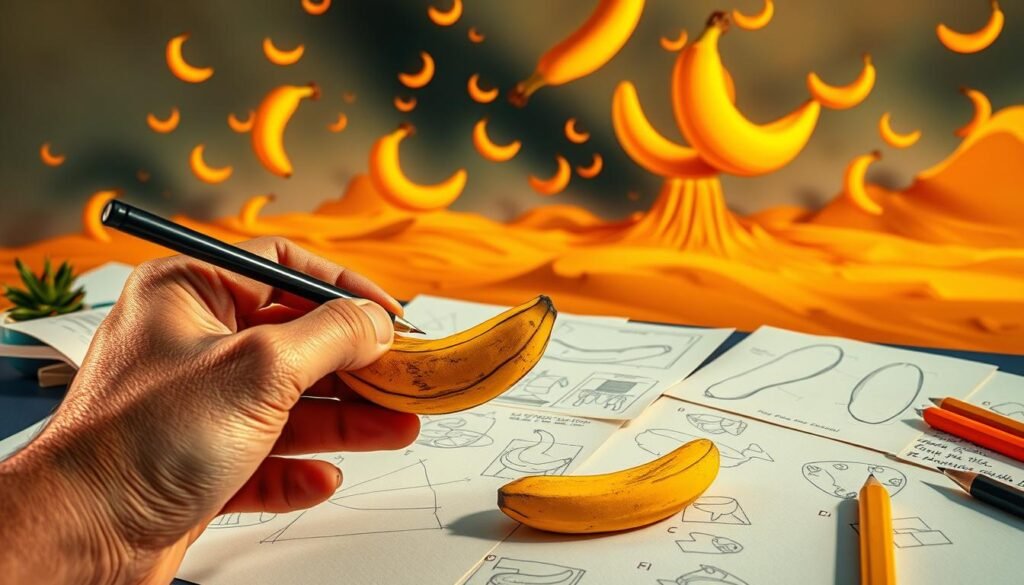
Even experienced artists encounter specific hurdles when perfecting their banana illustrations. This section addresses common stumbling blocks and provides refined techniques for achieving professional results.
Overcoming Common Drawing Challenges
Many students create rigid, straight forms instead of organic curves. I emphasize studying natural curvature during the initial sketch phase. The subtle arc distinguishes convincing artwork from amateur attempts.how-to-draw-a-pumpkin
Sharp, pointy ends frequently plague beginner illustrations. During construction, I recommend using small circles at both termination points. This technique ensures rounded, natural-looking ends banana rather than artificial angles.
Color blending difficulties often result in harsh transitions. I advise using clean brushes with light pressure for smooth gradations. Building darkness gradually prevents irreversible overapplication.
| Common Challenge | Visual Symptom | Professional Solution | Result Improvement |
|---|---|---|---|
| Overly straight shape | Rigid, unnatural appearance | Exaggerate initial curve slightly | Organic, flowing form |
| Sharp ends | Pointy termination points | Use oval guides during construction | Rounded, realistic tips |
| Harsh black outlines | Coloring book effect | Trace with corresponding colors | Seamless integration |
| Flat appearance | Lacking dimension | Enhanced bottom shading | Three-dimensional quality |
Refining Details to Enhance Realism
For the final banana drawing, I carefully eliminate harsh black outlines. Tracing with corresponding colors at each point creates seamless integration. Yellow dominates the body, while brown accents the ends.
The stalk benefits from fibrous texture suggestions. Using a fine brush with dark brown paint, I create short vertical marks. These subtle lines suggest natural stem separation.
When illustrating peeled sections, the inner part requires special attention. Light yellow shading along the peel’s inner rim captures subtle color variation. This detail significantly enhances authenticity.
Advanced artists should examine the end line where peel meets stem. This junction features a characteristic star-pattern when viewed directly. Each section creates distinct division lines radiating outward.how-to-draw-a-dragon-comprehensive-guide-for-beginners
Conclusion
Mastering organic forms like the banana provides transferable skills for countless drawing challenges. This comprehensive banana drawing tutorial has equipped you with professional techniques for creating impressive artwork.
The skills developed through this tutorial—understanding curves, shading, and texture—apply directly to other subjects. Your practice with this fruit builds a strong foundation for broader artistic growth.
Continue exploring different styles and using real references. Each sketch strengthens your observation skills and technical ability.
I’m confident these techniques will help you create wonderful artwork. The principles learned here serve artists throughout their creative journey.